YouTube Algorithm Changes 2026: Every Update
Every YouTube algorithm change in 2026, split into what YouTube confirmed and what creators claim, with sources and what each means for AI channels.

YouTube confirmed one ranking change in 2026. On October 1, the Shorts feed started cutting reach for channels that mostly re-upload other people’s clips. The rest of the year’s confirmed changes sit around ranking: how views get counted, who can earn, how AI videos get labeled, and where viewers find videos.
Most “2026 algorithm update” lists mix those facts with rumors. A January rebuild on Gemini, a 30-day cutoff for Shorts and a penalty for AI videos all appear in those lists. We could not find a YouTube source for any of the three.
So this page sorts every change into two piles. One pile has a YouTube source you can open. The other pile has creator reports with no source. Under each change we add one line on what it means for AI and faceless channels, because that is who we build for.
Every confirmed change, by date
Each row links to YouTube’s own post or video. Two rows rest on news reports, and the table says which.
| Date (2026) | What changed | Source | For AI and faceless channels |
|---|---|---|---|
| January 21 | CEO Neal Mohan names low quality AI content as a 2026 priority | YouTube Blog | The target is spam and clickbait, with AI as the tool that makes them cheap |
| May 27 | AI labels move under the player and onto Shorts. YouTube can add one by itself | YouTube Blog, Search Engine Journal | A label does not change recommendations or pay |
| July 16 | The inauthentic content rule splits into three named groups | Creator Insider | A pay rule. Templates in bulk and AI hosts on health or money topics cannot earn |
| August 10 | New Partner Program bar from February 1, 2027 | YouTube Blog | Shorts channels need 10 million qualified views every 90 days to share Shorts revenue |
| August 24 | Public views count from the first frame on every format | TeamYouTube | Your view count goes up. Your pay does not |
| September 23 | Made on YouTube: Shorts series, Custom Feeds, a wider Ask YouTube, video A/B tests | YouTube Blog, Google Blog | More ways to get found. No ranking change announced |
| October 1 | Shorts feed favors original videos and cuts reach for re-upload channels | TeamYouTube, Creator Insider | Original AI videos are not the target. Clip channels with a voiceover are |
YouTube never announced a rewrite of Home or Suggested ranking this year. The September interview with Todd Beaupré explains how ranking already works. He does not announce a new system.
October 1: Shorts reach now depends on original work
The Shorts feed now favors original videos. Channels that mostly re-upload other creators’ clips get less reach. No other 2026 update changes who sees a video.
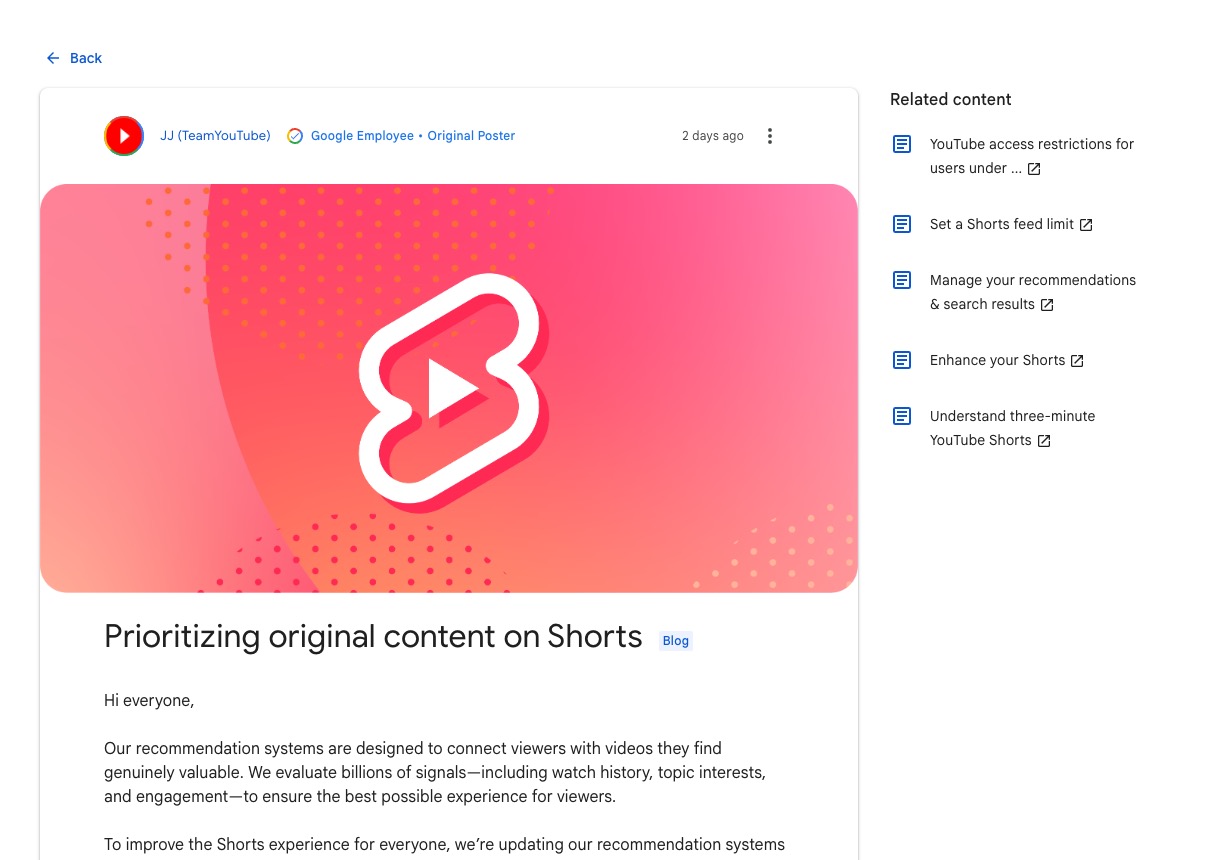
TeamYouTube wrote that these channels “will likely see less distribution within the Shorts feed.” The post works at channel level. It looks at what a channel mostly does, and one borrowed clip will not sink you.
The Creator Insider video from the same day lists what does not count as adding value. A voiceover that describes what is on screen does not count. Small technical edits do not count either, and neither do bulk changes made from a template. YouTube asks for your own commentary, analysis or story.
The same video offers a way back. A channel that moves to original work gets its reach looked at again. YouTube gave no timeline for that, and Studio has no flag that tells you a channel was marked.
What this means for AI and faceless channels. The update names re-uploads and never mentions AI. A Short built from your own script, with images made for that script, is original work. The channels at risk take movie scenes, podcast clips or other creators’ Shorts and add a voice on top. Many of those channels are faceless, which is why the two get mixed up.
We would take the “template-based changes” line seriously. A channel that posts the same video fifty times with one noun swapped is not re-uploading anyone. It still looks like the thing YouTube is describing. Give every video its own topic and its own arc.
Our guide to the Shorts originality update has a five-question channel check and the steps back for channels that re-upload today.
August 24: a view now starts at the first frame
Since August 24, YouTube counts a public view the moment a video starts to play. Shorts worked this way from March 2025. Long videos, podcasts and live streams now match.
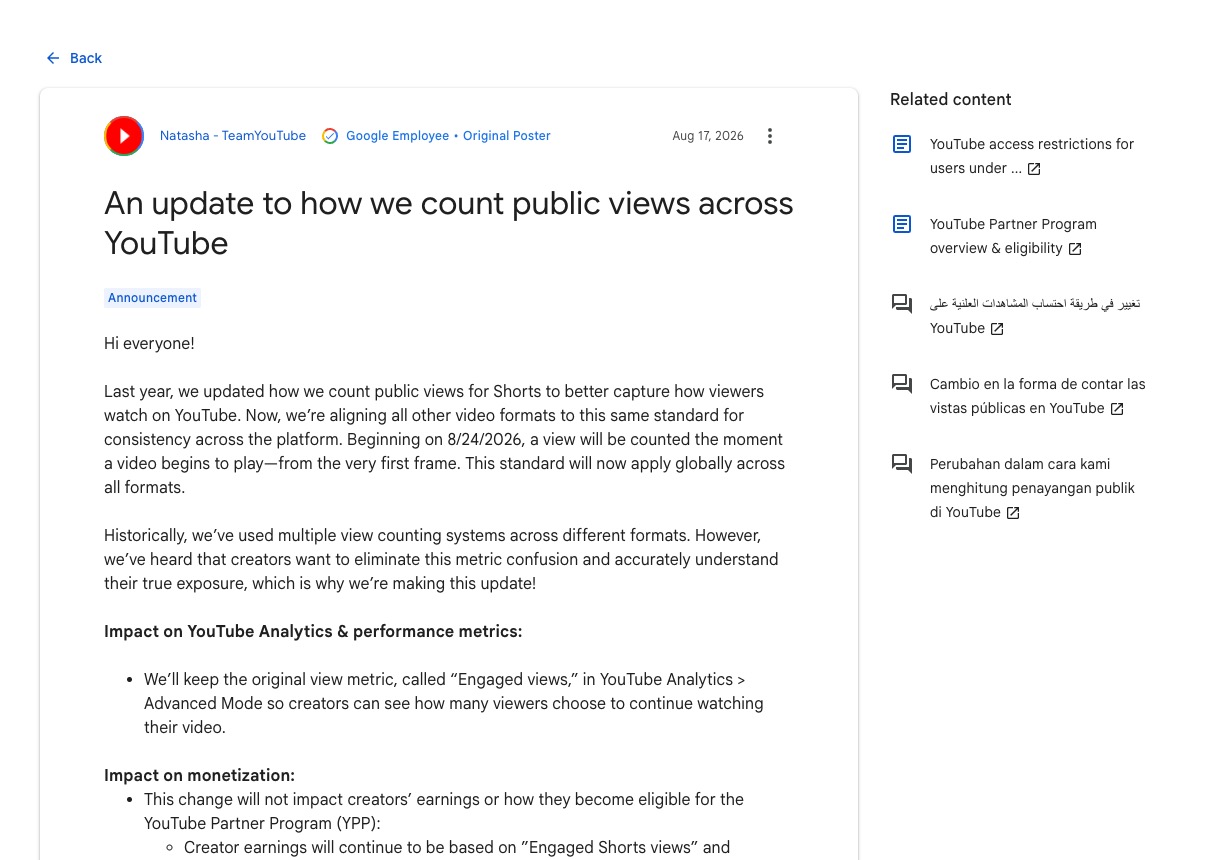
TeamYouTube’s post says the change “will not impact creators’ earnings” or how a channel gets into the Partner Program. The old number still exists. It is now called engaged views, and it sits in YouTube Analytics under Advanced Mode.
Two numbers now tell two stories. Public views show how often a video started playing. Engaged views show how many people chose to keep watching, and that second number drives pay. vidIQ’s video on the change shows how far apart the two can sit on a Shorts channel.
What this means for AI and faceless channels. Stop judging a Short by the number under it. A Short with 40,000 views and 9,000 engaged views has a hook problem. Open Advanced Mode before you decide a format works. Our guide to qualified watch hours and Shorts views covers which number counts where.
February 2027: the bar to earn goes up
New channels will need more to join the YouTube Partner Program from February 1, 2027. YouTube’s August 10 post calls these “the first significant changes since 2018.”
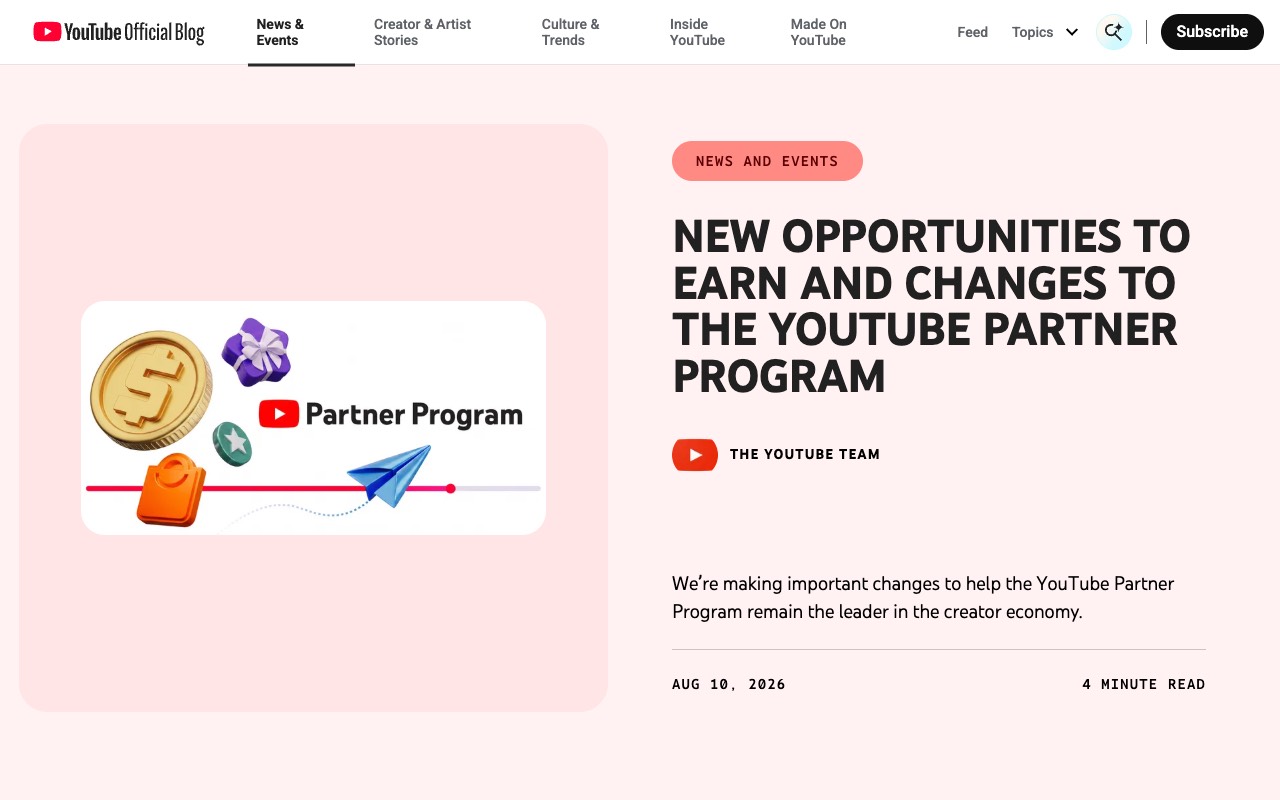
The new entry bar is 8,000 qualified watch hours in a year, or 20 million qualified Shorts views in 90 days. Channels already in the program keep their place.
Shorts pay gets a second gate. A channel needs 10 million qualified Shorts views over the last 90 days to share Shorts ad and subscription revenue. Drop below that and Shorts revenue pauses. It comes back when the channel crosses 10 million again. Long videos keep earning the whole time.
What this means for AI and faceless channels. Small Shorts-only channels lose the most. If Shorts are your whole plan, start adding long videos now, since watch hours have no rolling gate. Our Shorts monetization guide has the full math.
May and July: labels and the inauthentic content rule
These two changes decide what gets labeled and what gets paid. Neither one changes who sees a video.
On May 27 YouTube moved AI labels under the player and put them on top of Shorts. It can also add a label itself when it detects realistic AI video. YouTube’s Rene Ritchie said the labels “alone do not affect how our videos are recommended” or whether they earn. YouTube’s help page says the same in writing. Stylized and animated AI video needs no disclosure at all.
On July 16 Matt Halprin, who leads trust and safety, explained the inauthentic content policy on Creator Insider. YouTube now sorts it into three groups that cannot earn:
- Generic or repetitive videos, such as templates made in bulk.
- Off-putting or distressing videos that leave viewers feeling worse.
- AI personas that present on sensitive topics like health, money or law.
What this means for AI and faceless channels. The rule looks at sameness and never asks how a video was made. We would not run an AI host on a health or finance channel after July. A narrated explainer with drawn visuals sits outside that third group. We cover the details in does YouTube monetize AI videos, YouTube AI labels and inauthentic content strikes.
New places to get found
YouTube spent 2026 building new ways for viewers to ask for videos. None of them changes how Home ranks your upload. All of them reward a video that answers one clear question.
Ask YouTube is a chat-style search. It launched at Google I/O in May and reached phones and TVs in the United States in August. TechCrunch reports it can send a viewer to the exact second of a video that answers them.
Custom Feeds let a viewer build a feed around a mood or a topic. Shorts series group Shorts into seasons and episodes that play in order. Both came out of Made on YouTube on September 23.
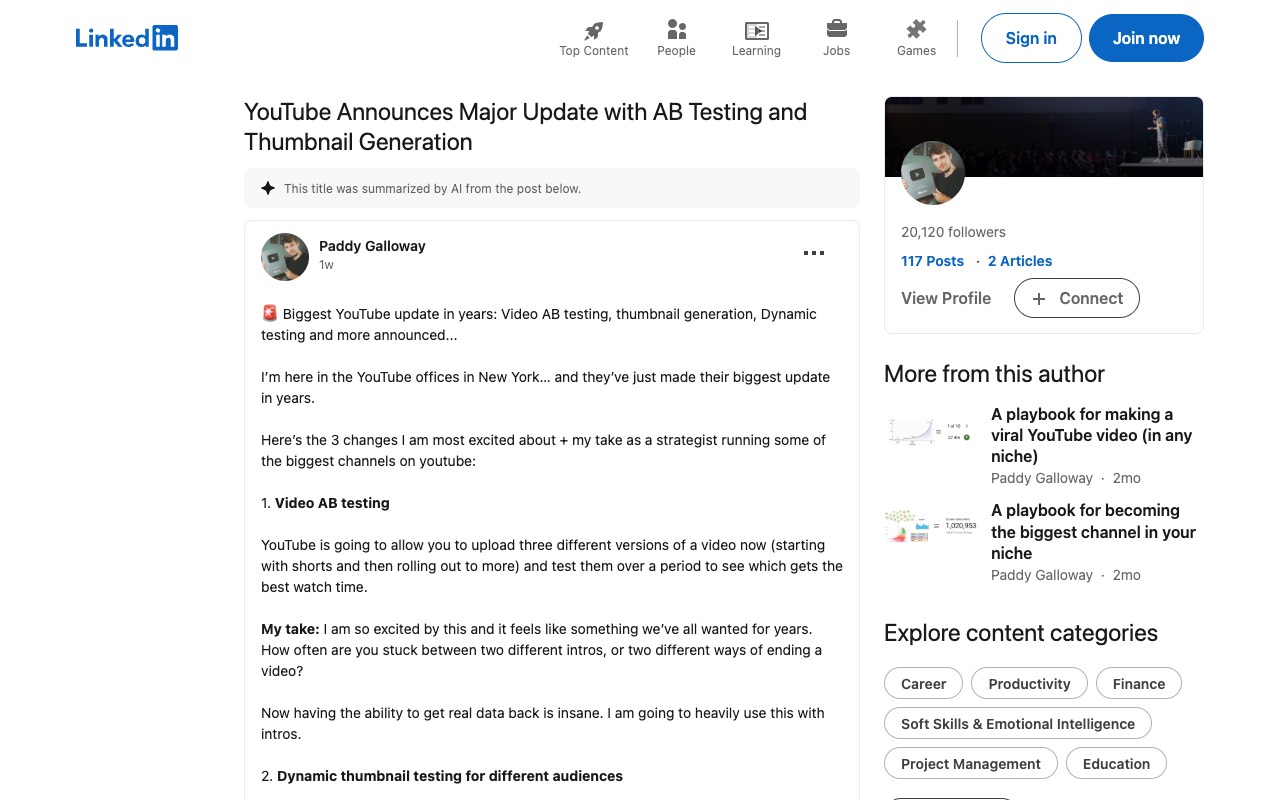
Video A/B testing was shown at the same event. Strategist Paddy Galloway was in the room and wrote on LinkedIn that creators will upload three versions of a video and YouTube will test them on watch time. It starts with Shorts. His plan: “I am going to heavily use this with intros.” YouTube says the feature will roll out over the coming months.
What this means for AI and faceless channels. Series suit story formats, so plan a run of five Shorts in place of five one-offs. Three-version testing rewards channels that can make a second and third intro cheaply. That is the part of the job AI tools handle well.
How ranking works, in YouTube’s own words
YouTube ranks videos one viewer at a time, at the moment that viewer opens the app. Todd Beaupré said so in the Creator Insider interview on September 1. He leads growth and discovery at YouTube.
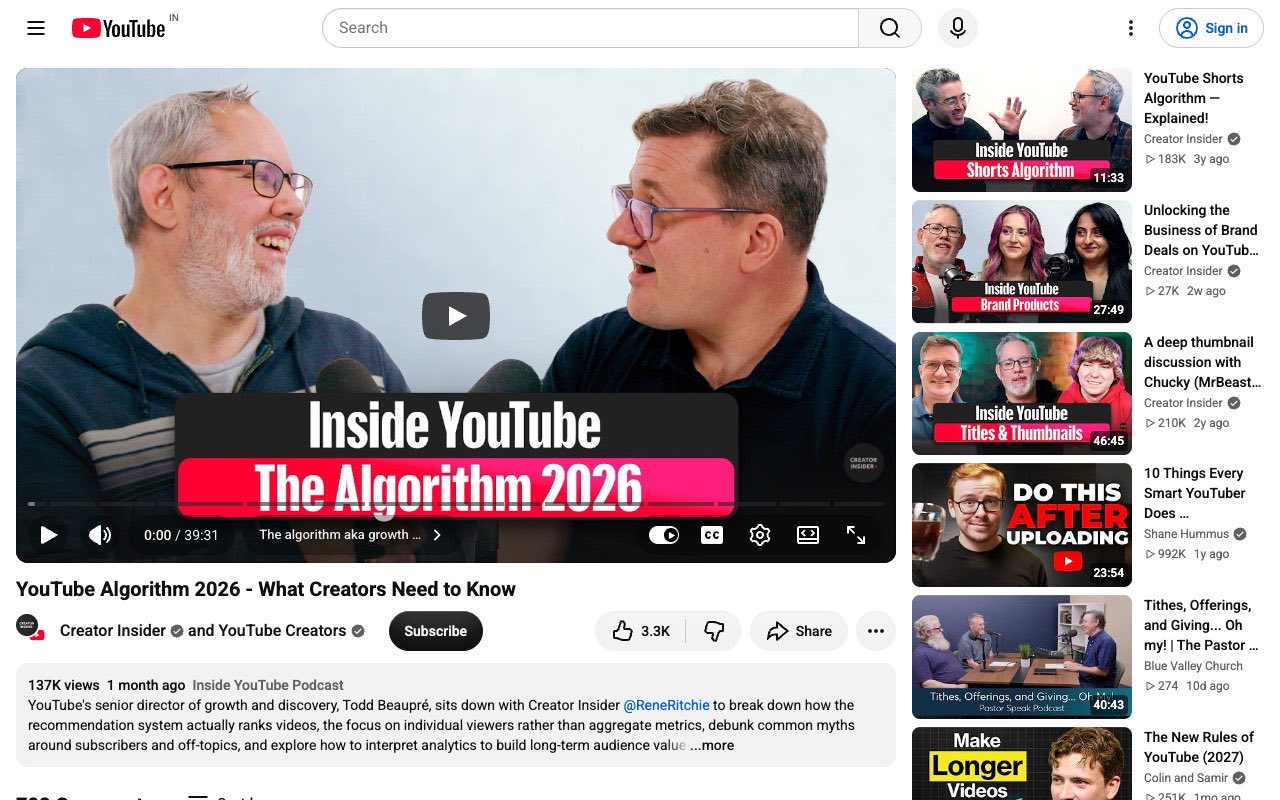
Creators talk about the algorithm pushing a video out. Beaupré describes the reverse: “most of the recommendations are more pulled for each viewer.” The system looks at what that viewer has watched, the time of day and the device. Then it ranks a set of videos for that viewer alone.
Four points from the first ten minutes of the interview answer common fears.
- Subscribers are not a test group. Beaupré says videos reach people who have never watched the channel within the first hour.
- The first hours do not seal a video’s fate. Many videos get most of their views a month or more after upload.
- One group’s reaction does not decide for everyone. The system learns separately for subscribers and for new viewers.
- Viewers miss uploads on their own. Beaupré tells of one viewer who was shown a channel’s new uploads 19 times and never noticed.
He presents all of this as how the system already works. Nothing in the interview is dated to 2026.
What creators say changed, and what has no source
Creators reported big view drops at several points this year. One March video, The YouTube Views Drop Is Becoming A Big Problem, drew tens of thousands of views. The reports are real. The causes people attach to them have no YouTube source.
| Claim | Who says it | What we found |
|---|---|---|
| YouTube rebuilt recommendations on Gemini in January | Creator threads and SEO blogs | No YouTube post. The confirmed Gemini feature is Ask YouTube |
| Shorts lose reach after about 30 days | Strategist Mario Joos, reported by Search Engine Journal | Joos called it a working theory. YouTube has not answered it |
| Home shows fewer long videos than before | Creators on social media | No YouTube statement either way |
| YouTube down-ranks AI or faceless videos | Creator videos and news posts | YouTube says labels do not affect recommendations. The pay rule tests sameness |
| A “2026 algorithm shift” caused the view drops | Creator videos and forums | No YouTube statement confirms a ranking change |
We would not tell anyone their drop was the algorithm. We would not tell them it was not, either. YouTube explains how the system works. Creators describe how large their drops were. Those are different questions, and YouTube can change things without a blog post.
If your own Shorts are slow, run the eight checks in YouTube Shorts not getting views before you settle on a cause.
Want every platform update, with the ones that have nothing to do with AI included? OutlierKit keeps a running list of YouTube algorithm updates. We use it for research, and it pairs well with this page.
What we would do with all this
Make each video original, then make more versions of your best ideas. That order matters after October 1.
- Write one clear idea per video. A new topic or a new angle each time keeps you clear of the template problem.
- Find the idea before you make anything. OutlierKit shows which videos beat their own channel’s average, so you start from formats that already work.
- Judge Shorts on engaged views. Public views now include every swipe past.
- Make two or three openings for the ideas you believe in. YouTube’s video A/B test will pick a winner once it reaches you.
- Add long videos if Shorts are your only format. The 2027 Shorts gate resets every 90 days. Watch hours do not.
- Skip AI presenters on health, money and legal topics. Narration over visuals is the safer format there.
Step 4 is where AITuber helps. It turns a script into a finished video with images, a voice and captions, and it can post on a schedule. A second version of a Short takes a few minutes. AITuber Creator costs $39 a month for 2,500 credits. That covers about 71 Shorts of 30 seconds with AI images.
AITuber does not pick your idea or your angle. It cannot promise reach or pay. If every video on a channel uses one script with the names swapped, a faster tool makes the problem bigger. The idea is your part of the work.
Wondering how often to post? YouTube sets no number. We explain the pace we would pick in how many YouTube Shorts to post a day.
Shorts channels can start with the AI YouTube Shorts generator. For longer videos, use the long-form AI video generator. Our Shorts algorithm guide goes deeper on Shorts ranking signals.
Change log
We update this page when YouTube confirms a change.
- October 1, 2026: Shorts feed favors original videos. Re-upload channels get less reach.
- September 23, 2026: Made on YouTube. Shorts series, Custom Feeds, Ask YouTube expansion, video A/B tests.
- September 1, 2026: Todd Beaupré explains ranking on Creator Insider. No change announced.
- August 24, 2026: Public views count from the first frame on all formats.
- August 10, 2026: Partner Program changes announced for February 1, 2027.
- July 16, 2026: Inauthentic content policy explained in three groups.
- May 27, 2026: AI labels move and can be added by YouTube.
- January 21, 2026: CEO letter names low quality AI content as a priority.
Frequently Asked Questions
Did the YouTube algorithm change in 2026?
One confirmed ranking change happened. On October 1, 2026, the Shorts feed began favoring original videos and cutting reach for channels that mostly re-upload clips. YouTube announced no rewrite of Home or Suggested ranking.
Does YouTube suppress AI videos?
YouTube has not said so. Rene Ritchie said in May 2026 that AI labels alone do not affect recommendations or pay. The help page on AI disclosure says the same. The rules that do bite are about repeated templates and re-uploads.
Is the October 2026 Shorts update bad for faceless channels?
Only for faceless channels built on other people’s clips. The update targets channels that mostly re-upload without real changes. A faceless channel with its own scripts and its own visuals makes original work.
Why did my YouTube views drop in 2026?
Nobody outside YouTube can say for sure. Creators reported drops at several points in the year, and YouTube confirmed no ranking change before October. Check engaged views, traffic sources and season before you blame the algorithm.
Do views count differently now?
Yes. Since August 24, 2026, a public view counts when a video starts to play. Pay and Partner Program entry still use engaged views and qualified watch hours.
What are the new YouTube Partner Program requirements?
From February 1, 2027, new channels need 8,000 qualified watch hours in a year or 20 million qualified Shorts views in 90 days. Sharing Shorts revenue needs 10 million qualified Shorts views in the last 90 days.
Do Shorts stop getting views after 30 days?
That is a creator theory. Strategist Mario Joos raised it in late 2025, and YouTube has not confirmed it. Beaupré said in September 2026 that many videos get most of their views a month or more after upload.
How often does YouTube change the algorithm?
The system learns all the time, so small shifts never stop. Announced changes are rare. In 2026 YouTube announced one for Shorts, in October.
How we researched this: we opened every YouTube source linked above on October 3, 2026, including both TeamYouTube threads, the Creator Insider videos, the Partner Program post and the CEO letter. We read the first ten minutes of the Beaupré interview transcript and quote only from that part. The AI label and Ask YouTube details come from Search Engine Journal and TechCrunch reports, and we checked the three policy groups against TechCrunch’s write-up. AITuber prices come from our pricing page.