YouTube Shorts Originality Update: Who Loses Reach
From October 1, 2026 the Shorts feed gives less reach to channels that mostly re-upload clips. See what counts as original and where AI Shorts stand.

On October 1, 2026, YouTube changed how the Shorts feed ranks channels. Channels that mostly re-upload other creators’ clips now get less reach. Original Shorts get more room. The change covers reach in the Shorts feed. YouTube’s post says nothing about pay.
This is the only ranking change YouTube confirmed in 2026. It names re-uploads. It never mentions AI. Still, plenty of faceless channels are built on clips, so the two groups overlap, and that is where the worry comes from.
What YouTube changed on October 1
The Shorts recommendation system now puts original Shorts ahead of re-uploads. TeamYouTube wrote that channels “primarily aggregating or re-uploading other creators’ videos” without real changes will likely see less of the Shorts feed.
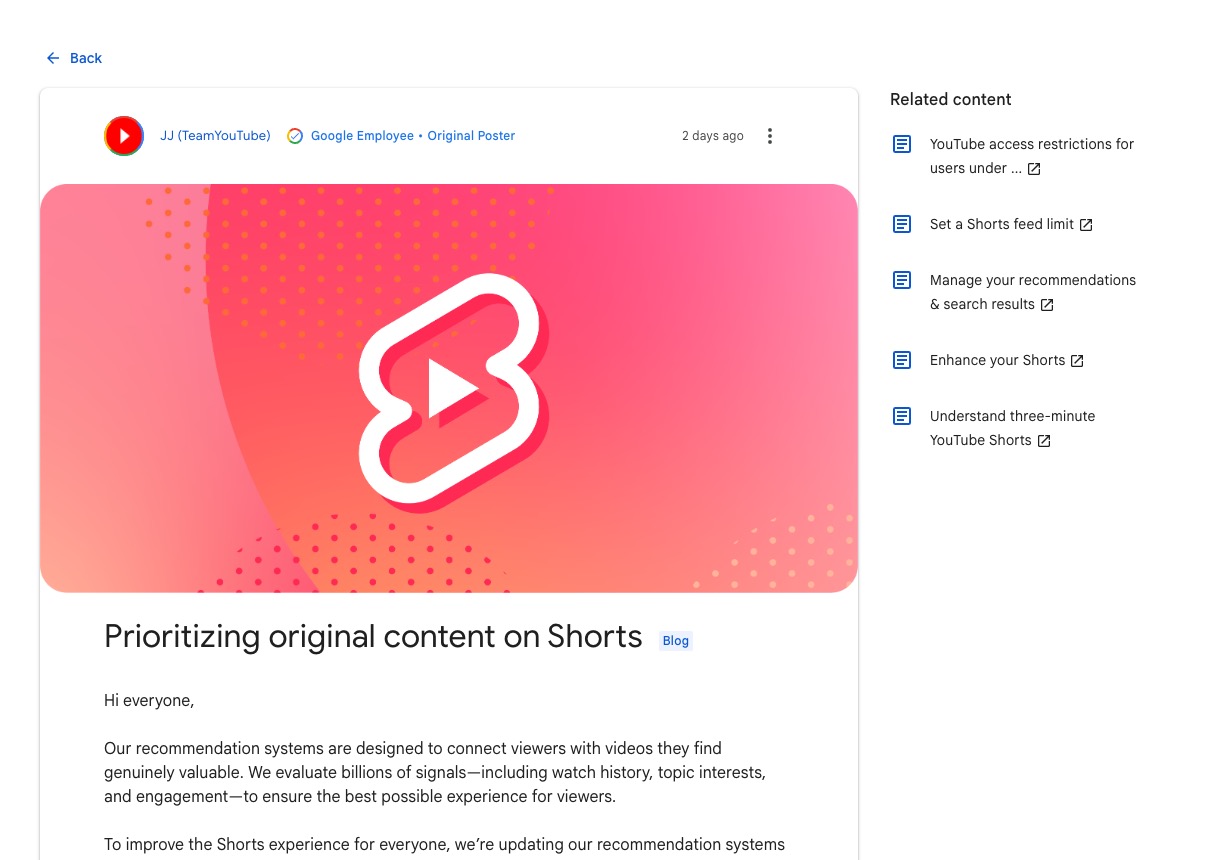
Three details in the post matter.
- It works on channels. The word “primarily” means YouTube looks at what a channel mostly posts. One borrowed clip does not mark you.
- It covers the Shorts feed. The post does not mention long videos, Search or Home.
- YouTube calls it “aligned with our existing YouTube policies.” Reused content already could not earn money. Now it also travels less.
What counts as original
YouTube gave both sides of the line. The Creator Insider video lists what does not count as adding value: voiceover that describes what is on screen, minor technical edits, and “template-based bulk changes.”
The same video lists what does count. Your own perspective, commentary, analysis and storytelling all qualify.
| What the channel posts | YouTube’s wording | Our read |
|---|---|---|
| Your own script with visuals made for it | Original content | Safe |
| A movie scene with a voice that retells it | Voiceover describing the screen | At risk |
| Another creator’s Short, cropped or sped up | Minor technical edits | At risk |
| One format with a swapped noun, in bulk | Template-based bulk changes | At risk |
| A clip with your own analysis over it | Commentary and analysis | Safe |
| A clip you love, shared with no changes | YouTube says use the Posts tab | Do not upload it as a Short |
The last row comes straight from the video. If you only want your audience to see someone’s clip, YouTube asks you to share it in a post so viewers watch the original.
The third column is our judgment. YouTube has not published a test or a threshold.
Where AI and faceless channels stand
A Short made from your own script is original work, whatever tool made the pictures. Nothing in the post or the video mentions AI, faces or voices.
YouTube said the same thing about labels in May. Rene Ritchie said AI labels do not affect how videos are recommended, and the help page on AI disclosure says disclosure will not limit a video’s audience.
So the split runs through the faceless world. A history channel that writes each script and generates its own scenes is on the safe side. A “movie recap” channel that plays the film and narrates the plot is on the other side. Both are faceless, and only the recap channel re-uploads.
Count how much of each Short someone else made. If the footage is theirs and only the voice is yours, you are in the group YouTube described.
The template warning applies to AI channels too
“Template-based bulk changes” is the phrase AI creators should read twice. YouTube used it about altered clips. We think it describes a second habit as well.
Some channels post the same Short fifty times with one detail swapped. They use the same hook and the same beats and change only the name in the middle. Nobody’s clip is re-uploaded, so the October update may not touch them. The inauthentic content policy already does, on the pay side.
We would not build on that pattern. YouTube has now pushed against sameness twice in four months, once for pay in July and once for reach in October. Give each Short a topic of its own, plus an opening and an ending that fit it.
Check your channel in five questions
Run these on your last twenty Shorts.
- Who made the footage? Count the Shorts where someone else’s video fills most of the screen.
- What did you add? A voice that retells the clip does not count. An opinion, a lesson or a story does.
- Would a viewer learn something new from your version? If the original says it all, yours adds nothing.
- Do your Shorts differ from each other? Line up five. If only one word changes, you have a template problem.
- Could you explain each Short’s idea in one sentence? If the sentence is the same every time, see question 4.
More than half “someone else” on question 1 puts you in the group YouTube described.
What to do if your channel re-uploads today
YouTube left a way back. The Creator Insider video says that when a channel shifts to original content, “the recommendation system will re-evaluate reach.”
- Stop posting straight re-uploads. Each one adds to the pattern YouTube measures.
- Keep the niche and change the source. A movie channel can post its own ranked lists, theories or scene breakdowns.
- Put your own take in the first three seconds. Commentary that arrives at second twenty looks like narration.
- Share clips you love on the Posts tab, with credit.
- Watch Shorts feed traffic in Analytics for a few weeks. YouTube gave no timeline, so patience is part of this.
We would not delete old Shorts in a panic. YouTube did not ask for that, and nothing in either source says old uploads need to go.
What YouTube has not said
Four gaps remain. We would rather name them than guess.
- No start date beyond the announcement. The post says YouTube is “updating” its systems.
- No number for “primarily.” Nobody outside YouTube knows the share of re-uploads that tips a channel.
- No flag in Studio. A channel cannot see whether it was marked.
- No word on original AI Shorts. Neither source mentions them, which is why we read the rule from its wording.
We will update this page when YouTube fills any of these in. Every other 2026 change is in our YouTube algorithm changes log.
How AITuber fits
AITuber makes original videos from a script. You bring the idea, or pick one and edit the script it drafts. It generates images for each line, adds a voice and captions, and can post on a schedule. It does not download or re-cut other people’s videos.
It cannot make a channel original for you. If you feed it one script with the names changed, you get the template problem faster. The idea and the angle are still your job.
Shorts channels can start with the AI YouTube Shorts generator. Need ideas first? OutlierKit shows which videos beat their own channel’s average, so your next original idea starts from a format that works.
Frequently Asked Questions
What is the YouTube Shorts originality update?
It is a change to Shorts recommendations announced on October 1, 2026. YouTube now favors original Shorts and gives less reach to channels that mostly re-upload other creators’ clips without real changes.
Does the update affect AI-generated Shorts?
Not by itself. YouTube’s post and video never mention AI. A Short made from your own script with visuals generated for it is original work. AI channels that re-upload clips or post one template in bulk carry the risk.
Does the update affect monetization?
The announcement is about reach in the Shorts feed. Pay is covered by separate rules. Reused and inauthentic content already could not earn money under the Partner Program policies.
Are faceless channels affected?
Only faceless channels built on other people’s footage. YouTube’s wording targets re-uploads, voiceover that describes the screen, small edits and bulk template changes. Showing your face is not part of the test.
Can a channel recover its reach?
YouTube says yes. When a channel that re-uploaded moves to original content, the recommendation system looks at its reach again. YouTube has not said how long that takes.
Is commentary on someone else’s clip still allowed?
Yes. YouTube names commentary, analysis and storytelling as real value. A voice that only describes what the clip already shows does not count.
Should I delete my old re-uploaded Shorts?
YouTube did not ask creators to delete anything. The update looks at what a channel mostly posts, so changing what you upload next is the step that matters.
How we researched this: we read TeamYouTube’s post and the transcript of the Creator Insider video on October 3, 2026, and every quote comes from those two sources. The label statement comes from Search Engine Journal’s May 27 report and YouTube’s help page. The “our read” column and the five questions are our own judgment. YouTube has not published a test.