AITuber vs Revid.ai vs AutoShorts.ai (2026)
AITuber, Revid.ai, and AutoShorts.ai compared on live July 2026 pricing, credit costs, channel limits, and refund policies.

These three tools all post faceless videos for you, but they charge for three different things. AutoShorts.ai sells you a posting schedule. Revid.ai sells you a pool of credits. AITuber sells you credits plus the number of channels you run. Pick the wrong one and you pay for a limit you did not know existed. All pricing below was read off each vendor’s live page on 31 July 2026.
Key takeaways
| Question | AITuber | Revid.ai | AutoShorts.ai |
|---|---|---|---|
| Cheapest paid plan | $29/mo | $39/mo | $19/mo |
| Free plan | Yes, 100 credits | No | Paused since July 2026 |
| Channels per subscription | 1 to unlimited by plan | Not published as a cap | 1 series on every plan |
| Cost per 30-second short | About $0.43 to $0.57 | About $0.78 to $1.56 | About $1.15 to $1.46 |
| Refund on a bad video | Failed jobs auto-refunded | Not published | No refunds, by policy |
What you are actually buying
Start here, because it explains every other difference. The three tools meter three different things.
AutoShorts.ai meters how often you post. Every plan is a posting schedule: three times a week, once a day, or twice a day. You are buying a cadence, not a video count.
Revid.ai meters how much you generate. You get a credit pool each month and spend it on clips, voices, and exports. Post as often as you like until the credits run out.
AITuber meters both. Plans set a credit pool and a channel count. Credits cover the making, and the channel count covers the publishing.
This is why price alone tells you almost nothing here. AutoShorts.ai looks cheapest at $19 a month. It also caps you at three posts a week on one channel, forever.
The three tools side by side
| AITuber | Revid.ai | AutoShorts.ai | |
|---|---|---|---|
| Entry price | $29/mo | $39/mo | $19/mo |
| Free tier | 100 credits, no card | None | Paused |
| What a plan meters | Credits and channels | Credits | Posts per week |
| Auto-post to YouTube, TikTok, Instagram | Yes | Yes, from Growth up | Yes, all plans |
| Feature gating by plan | None | Yes, on Hobby | None |
| Long-form video | Yes | Yes | No, 90 seconds max |
| Public API | Yes | Yes, from Growth up | No |
| Credits expire | No | Monthly reset | Motion credits reset |
| Refunds | Failed jobs auto-refunded | Not published | None, by policy |
| Trustpilot | No profile | 4.0 from 298, claimed | 3.2 from 13, unclaimed |
Two rows deserve a closer look, and they get their own sections below: the channel limit, and what happens when a video comes out wrong.
Pricing, plan by plan
AITuber

AITuber writes the script, makes the visuals, adds an AI voice, captions the video, and posts it on a schedule. Every plan includes every template, voice, style, and 4K export. Plans differ only by credits and channel count.
Key features
- One pass from topic to a finished, captioned MP4
- Autopilot publishing to YouTube, TikTok, Instagram, Facebook, Threads, and X
- Every template, voice, and style on every paid plan
- Credits never expire, so a quiet month is not wasted
- Failed generations refund your credits automatically
- A public API, an MCP server, and agent skills
- Niche templates for horror, true crime, history, and more
Pros
- Cheapest cost per finished short of the three
- Channel count grows with the plan, up to unlimited
- No feature gating, so the $29 plan makes the same videos as the $499 one
- Long-form video, not just shorts
Cons
- No lifetime deal or one-off purchase
- Credit maths takes a minute to learn if you only want a fixed video count
- We build it, so treat our verdict on it with that in mind
Pricing: Free to start with 100 credits and no card. Paid plans are Creator $29/mo (1,800 credits, 1 channel), Pro $49/mo (4,000 credits, 2 channels), Studio $89/mo (8,000 credits, 4 channels), Agency $149/mo (15,000 credits, unlimited channels), Business $349/mo (35,000 credits) and Enterprise $499/mo (50,000 credits). A 30-second short at basic quality is about 35 credits, so Creator covers about 51 shorts a month and Pro about 114.
User reviews: AITuber has no Trustpilot or G2 profile yet, so there is no third-party score to quote. We have not invented one.
Best for: a faceless channel you plan to grow, especially past the first channel.
Revid.ai
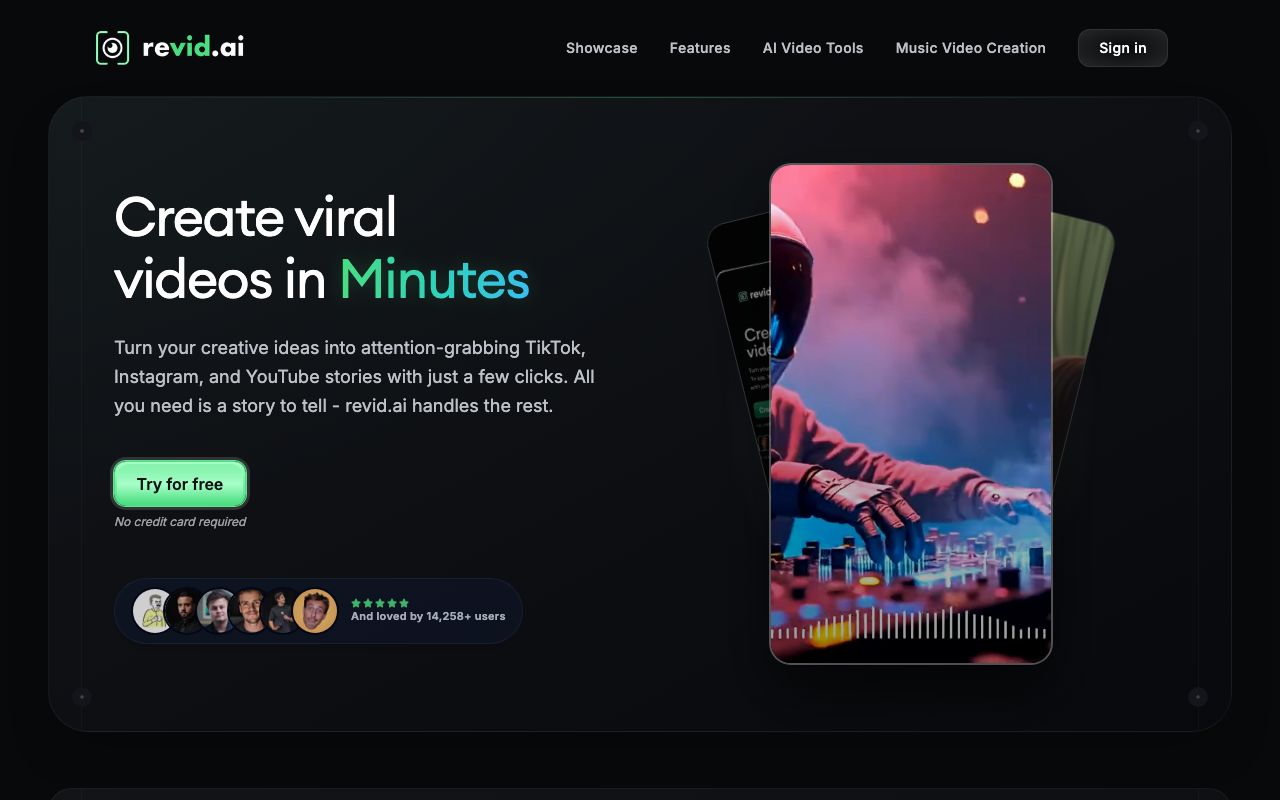
Revid.ai is the most editor-like of the three. You get a large model menu, a library of viral videos to remix, and fine control over each clip. It publishes to TikTok, Instagram, and YouTube, and it exposes an API, an MCP server, and a CLI.
Key features
- A wide model menu, including Google Veo 3, Sora 2, and Seedance
- 3 million viral videos to remix
- Voiceovers in more than 70 languages
- Hooks, scripts, and rewrites built in
- AI avatars, face swaps, and podcast formats
- Full API, MCP, and CLI access on Growth and above
- Auto-Mode Workers that run generations for you
Pros
- The most control over individual clips and models
- Strong Trustpilot record for a tool this size, 4.0 from 298 reviews
- API and MCP included at the $39 tier, not held back for an enterprise plan
- Voice cloning on the Ultra plan
Cons
- No free plan, so testing costs money
- The Hobby plan is heavily gated: no publishing, no voiceovers, no API
- Premium models burn credits fast, up to 1,000 for one Seedance 4K clip
- Credits reset monthly rather than rolling over
- Its FAQ lists an Elite plan at $89 that the pricing page does not show
Pricing: No free plan. Hobby is $39/mo, or $32/mo billed $384 yearly. Growth is listed at $99 and promoted at $39/mo with 2,000 credits, also $32/mo billed yearly. Ultra is $199/mo, or $166/mo billed $1,992 yearly, with 12,000 credits and a slider up to 200,000. Revid’s own FAQ says a typical 30-second video with moving images costs roughly 40 to 80 credits.
User reviews: 4.0 out of 5 from 298 reviews on a claimed profile (Trustpilot). Reviewers praise the interface and the visual quality. Cost is the most common complaint.
Best for: creators who want to shape each clip and pick the model behind it.
AutoShorts.ai

AutoShorts.ai is the simplest of the three to start. You pick a topic, choose an art style, connect a channel, and it posts on a schedule. It is built around one idea called a Series, which is a topic plus a posting schedule that runs on its own.
Key features
- Set up a Series once and it creates and posts by itself
- Dozens of art styles, plus custom prompts
- Auto-posts to TikTok, YouTube, and Instagram
- Preview and edit each video before it goes out
- Voice cloning, background music, and HD export on every paid plan
- Motion credits animate the still images in a video
Pros
- Cheapest entry price of the three at $19 a month
- No feature gating at all, every paid plan has the same features
- The fastest setup if you want one channel and nothing else
- Yearly billing gives two months free
Cons
- Every plan is capped at one Series, including the $69 plan
- Running a second channel means a second account and a second subscription
- Short-form only, capped at 90 seconds, with no long-form option
- No refunds at all, stated as policy
- No API, so it cannot be scripted or wired into other tools
- The free plan has been suspended since July 2026
Pricing: Starter $19/mo posts three times a week with 27 motion credits. Daily $39/mo posts once a day with 62. Hardcore $69/mo posts twice a day with 124. Yearly plans are $190, $390, and $690, which is two months free. Every tier is limited to one Series. The $0 Free plan is listed but currently paused.
User reviews: 3.2 out of 5 from 13 reviews on an unclaimed profile (Trustpilot), which also notes the company has never invited customers to review it. We found no G2 listing. Thirteen reviews is far too small a sample to compare against Revid’s 298, so we have not charted it as if it were.
Best for: one channel, one topic, and the least setup work possible.
What a finished video actually costs
Here is the same job priced three ways: one 30-second short, at each tool’s mid plan.
The maths behind each bar:
- AutoShorts Daily, $39/mo. Posts once a day, so about 30 videos a month. That is $1.30 each. The $19 Starter works out to about $1.46, and the $69 Hardcore to about $1.15.
- Revid Growth, $39/mo. 2,000 credits, and Revid’s FAQ puts a typical 30-second video at 40 to 80 credits. That is 25 to 50 videos, or $0.78 to $1.56 each.
- AITuber Creator, $29/mo. 1,800 credits at about 35 credits per short is roughly 51 videos, or $0.57 each.
- AITuber Pro, $49/mo. 4,000 credits is about 114 videos, or $0.43 each.
Over a year of daily posting on one channel, the totals land close together: $348 for AITuber Creator, $384 for Revid Growth on yearly billing, and $390 for AutoShorts Daily on yearly billing. The gap that matters is not the yearly bill. It is what happens next.
The second channel test
This is the sharpest difference between the three, and it is easy to miss when you sign up.
AutoShorts.ai caps every plan at one Series. Not one Series on Starter and more on Hardcore. One Series on all of them, including $69 a month and $690 a year. Its own FAQ says an account can only be on one plan type at a time, and that the workaround for more is to create a separate account.
AITuber raises the channel count with the plan. Creator runs 1 channel, Pro runs 2, Studio runs 4, and Agency and above run unlimited channels.
Revid.ai does not publish a channel cap. It publishes to TikTok, Instagram, and YouTube from Growth up, and it counts automation in Auto-Mode Workers: 3 on Growth, 10 on Ultra. Those are automation slots, not documented channel limits, so we are not going to claim a number Revid has not published.
Why this matters: most faceless creators start a second channel. It is the normal way to test whether a niche works. On AutoShorts.ai that means a second account and a second bill, so two daily channels cost $78 a month. On AITuber, two channels are the $49 Pro plan.
What happens when a video comes out wrong
AI video fails. A voice clips, a scene misreads the script, or a render dies. What the tool does next is a real cost, and the three answer it very differently.
AutoShorts.ai does not refund anything. Its FAQ is direct about it: the GPU cost is already spent, its upstream providers do not refund it, and you agree to waive refunds at signup. You can cancel, and your access runs to the end of the period.
Revid.ai does not publish a refund policy. We looked at its pricing page and FAQ on 31 July 2026 and found no stated policy either way. Credits are spent when you generate, so a reject costs the same as a keeper. With premium models that gets expensive fast: one Seedance 4K clip is 1,000 credits, which is half a Growth plan’s monthly pool.
AITuber refunds failed generations automatically and its credits never expire, so an unused month carries forward.
Where each tool genuinely wins
No tool wins everything, and it would be easy to stack this section. Here is the fair version.
AutoShorts.ai wins on simplicity and on honest plan design. Every paid plan has identical features. Voice cloning and no watermark are on the $19 plan, not held back for the $69 one. Very few tools in this category do that. If you want one channel running by tonight and nothing more, it is the shortest path.
Revid.ai wins on control and on model choice. It is the only one of the three that lets you pick between Veo 3, Sora 2, and Seedance for a given clip, and remix from a library of proven videos. Its 298-review Trustpilot record is also the strongest third-party evidence any of the three can point at. If your videos live or die on individual shots, Revid is the tool.
AITuber wins on cost per video and on room to grow. It is the cheapest per finished short, it is the only one of the three that does long-form, and it is the only one where the channel count moves with the plan.
Ratings, and how much to trust them
Third-party scores are useful, but only with the sample size and profile status next to them.
| Tool | Trustpilot score | Reviews | Profile status | How much weight |
|---|---|---|---|---|
| Revid.ai | 4.0 out of 5 | 298 | Claimed since March 2025 | Meaningful |
| AutoShorts.ai | 3.2 out of 5 | 13 | Unclaimed, no review invites | Too small to compare |
| AITuber | No profile | 0 | None | No evidence either way |
Scores checked on 31 July 2026. A 3.2 from 13 reviews and a 4.0 from 298 are not comparable numbers, so we have not drawn them on the same chart. AITuber has no profile at all, which is not a point in our favour either.
How to choose
Four questions settle it for most people.
- Will you ever want a second channel? If yes, rule out AutoShorts.ai, or budget for a second subscription.
- Do you need to test before paying? Only AITuber has a live free tier right now. Revid has no free plan, and AutoShorts has paused its own.
- Do you care which model makes each clip? If yes, Revid.ai is the only one that gives you that menu.
- Do you want long-form as well as shorts? AutoShorts.ai caps at 90 seconds, so it is out.
Use-case cheat sheet
| Your situation | Best pick | Why |
|---|---|---|
| First faceless channel, testing a niche | AITuber | Free credits, and no lock-in if the niche flops |
| One channel, minimum effort, forever | AutoShorts.ai | Cheapest entry and the fastest setup |
| Posting three shorts a day | AITuber Pro | 114 shorts a month at about $0.43 each |
| Running four niche channels | AITuber Studio | Four channels on one $89 plan |
| Client work across many channels | AITuber Agency | Unlimited channels at $149 |
| Videos that need specific shots | Revid.ai | Pick between Veo 3, Sora 2, and Seedance |
| Remixing proven viral formats | Revid.ai | 3 million video library to remix from |
| Long-form as well as shorts | AITuber or Revid.ai | AutoShorts is capped at 90 seconds |
| Wiring video into your own app | AITuber or Revid.ai | Both ship an API and an MCP server |
| Tight budget, one channel, three posts a week | AutoShorts.ai Starter | $19 a month with no feature gating |
Frequently Asked Questions
Basics
What is the main difference between AITuber, Revid.ai, and AutoShorts.ai?
They charge for different things. AutoShorts.ai charges for how often you post, from three times a week to twice a day. Revid.ai charges for a pool of credits you spend on generating. AITuber charges for credits and for how many channels you run on autopilot.
Which one is easiest to set up?
AutoShorts.ai. You pick a topic, choose an art style, connect a channel, and it starts posting. There is less to configure because there is less you can change.
Do all three post to YouTube, TikTok, and Instagram automatically?
Yes, with one catch. AutoShorts.ai and AITuber do it on every paid plan. Revid.ai includes publishing from its Growth plan up, but not on the cheaper Hobby plan.
Can any of them make long-form video?
AITuber and Revid.ai can. AutoShorts.ai cannot. Its FAQ says it focuses on short form up to 90 seconds, and that long form is being worked on but is not available.
Pricing
Which is cheapest?
AutoShorts.ai has the cheapest entry price at $19 a month. AITuber is cheapest per finished video, at about $0.43 to $0.57 per 30-second short against roughly $1.15 to $1.46 for AutoShorts.ai.
Does any of them have a free plan?
Only AITuber, as of 31 July 2026. It gives 100 free credits with no card. Revid.ai has never had a free plan. AutoShorts.ai lists one but has suspended it, which its FAQ blames on bot and spam abuse.
How much does one video cost on each tool?
On AITuber, a 30-second short is about 35 credits, so roughly $0.57 on the $29 plan. On Revid.ai, its FAQ puts a typical 30-second video at 40 to 80 credits, which is $0.78 to $1.56 on the $39 Growth plan. On AutoShorts.ai you buy a posting schedule, so the $39 Daily plan works out to about $1.30 per video.
Is yearly billing worth it?
It depends on the tool. AutoShorts.ai gives two months free, so Daily drops from $468 to $390 a year. Revid.ai drops to $32 a month, billed $384. AITuber is billed monthly with no annual lock-in, and its credits never expire.
Do any of them give refunds?
AITuber refunds failed generations automatically. AutoShorts.ai states it does not give refunds at all and asks you to waive the right at signup. Revid.ai does not publish a refund policy either way.
Comparisons
Is AITuber better than AutoShorts.ai?
For a channel you plan to grow, yes, mainly because AutoShorts.ai caps every plan at one Series. AutoShorts.ai is the better pick if you want one channel, the lowest entry price, and the simplest setup. We build AITuber, so weigh that.
Is AITuber better than Revid.ai?
They are good at different things. Revid.ai gives more control over each clip and lets you choose the model behind it. AITuber is cheaper per finished video and scales channels with the plan. If your videos depend on individual shots, Revid.ai is the stronger tool.
Can I run two channels on one subscription?
On AITuber, yes, from the $49 Pro plan. On AutoShorts.ai, no. Every plan is one Series, and its FAQ says the workaround is a second account. Revid.ai does not publish a channel cap.
Which has the best user reviews?
Revid.ai, on the evidence available. It has 4.0 out of 5 from 298 Trustpilot reviews on a claimed profile. AutoShorts.ai has 3.2 from 13 reviews on an unclaimed profile, which is too small a sample to weigh against it. AITuber has no third-party profile.
Which should I pick if I am starting today with no budget?
AITuber, because it is the only one of the three with a working free tier right now. Fifty credits is enough for a first short with voice and captions, and no card is needed.
How we researched this: pricing, plans, and policies here were read directly from each vendor’s live pages on 31 July 2026, not from pricing trackers. Revid.ai figures come from its pricing page and FAQ, including the monthly and yearly toggle. AutoShorts.ai figures come from its homepage, its FAQ, and the plan data its own site publishes, which is where the one-Series limit on every tier is confirmed. Trustpilot scores were read from the live profiles the same day, with sample size and claimed status noted because a 13-review score and a 298-review score are not comparable. AITuber is a product we build, so we have flagged every place we compare it to another tool and have not invented a review score for it. Prices, plans, and policies change often; check each vendor’s site for the latest.