MiniMax H3: What Open-Weights AI Video Means
MiniMax released H3 on July 31, 2026: 2K video, native stereo sound, and open weights promised within days. What that means for creators.

MiniMax released its H3 video model on 31 July 2026. It makes clips up to 15 seconds at 2K with native stereo sound. The specs are good but not record-breaking. The part that matters is the promise underneath them: MiniMax says it will publish H3’s model weights within days, which no other frontier video model has done.
What MiniMax actually shipped
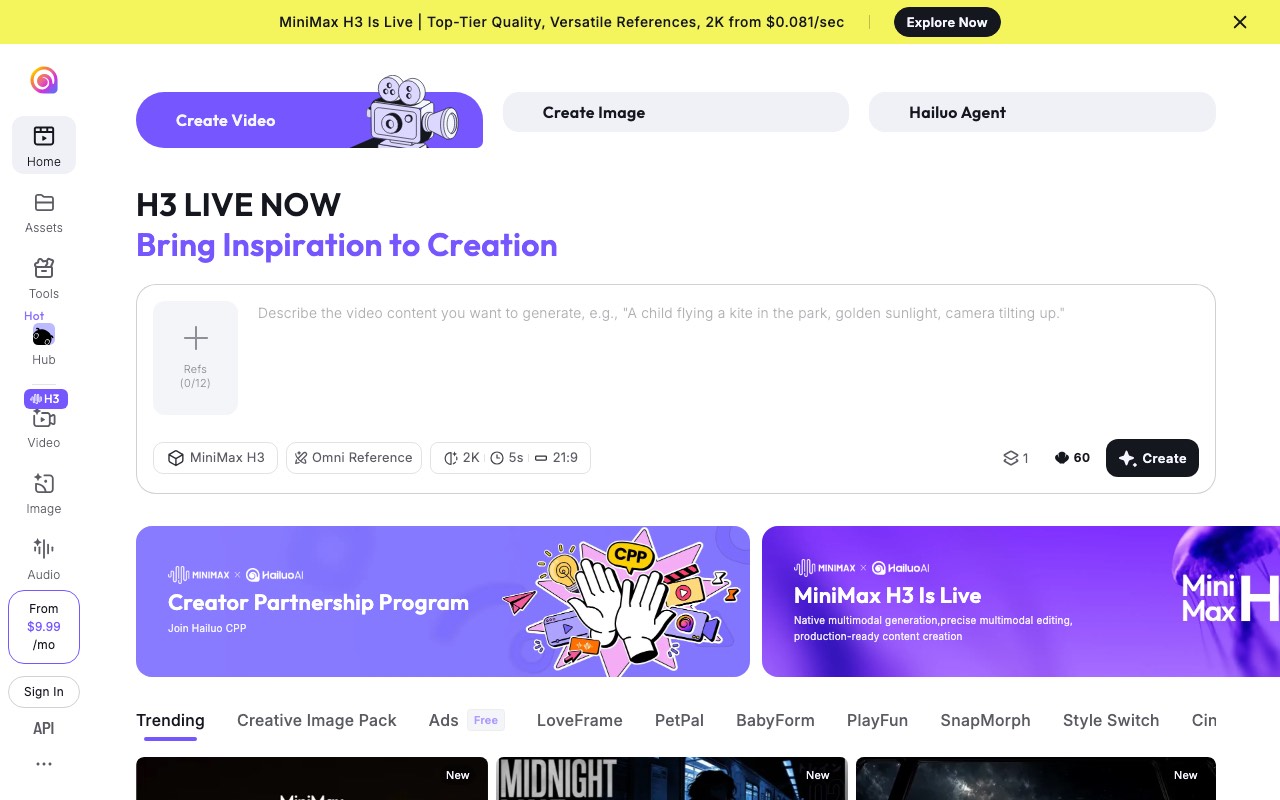
Here is what Reuters reported, and what we saw on MiniMax’s own Hailuo AI site the same day.
| Detail | What was announced |
|---|---|
| Release date | Friday 31 July 2026 |
| Clip length | Up to 15 seconds |
| Resolution | 2K |
| Audio | Native stereo sound |
| Inputs | Text, images, video, and audio |
| Editing | Edits existing footage, and transfers movement between videos |
| Model weights | Promised within days, not published yet |
| Target uses | Advertising, e-commerce, product design, and games |
| Hardware | Designed to run on several Chinese-made chips |
MiniMax was founded in 2022 and listed in Hong Kong in January 2026. On launch day its Hailuo site advertised H3 at 2K from $0.081 per second, with subscriptions from $9.99 a month. At that rate a full 15-second clip is about $1.22. We could not read the full plan details, because MiniMax puts subscription pricing behind a login.
Why open weights is the real story
Fifteen seconds is not a record. Google Veo, Kling, and ByteDance’s Seedance line all compete at or above this level, and ByteDance has publicly promised 30-second single-shot generation in a version that has not shipped yet.
What no rival has done is hand over the model.
Open weights means the trained model file is published. You can download it, run it on your own hardware, and adapt it. It is not the same as open source, because the licence still sets the rules for commercial use. Those terms matter and are worth reading when they appear.
The lock-in lesson
Creators learned this the hard way five months ago. OpenAI announced Sora’s shutdown in March 2026. The apps closed in April, and the API dies in September. Anyone who built a workflow on it had to move. We wrote up the Sora shutdown and the alternatives at the time.
That is the risk open weights answers. A hosted model can be discontinued, repriced, or restricted. A model file on a disk cannot.
The pattern is not rare, and it is not only about shutdowns. In the past few weeks alone we have checked three tools whose terms moved under their users:
- InVideo AI repriced on 27 July 2026 and removed its free plan.
- AutoShorts.ai suspended its free plan, which its own FAQ blames on bot and spam abuse.
- Kling AI allows a free tier, but its terms say generated content is not for commercial use.
None of those are scandals. Companies are allowed to change their pricing. The point is that every one of them changed something a creator was depending on, with no notice and no say.
What this does not change
Four caveats, because launch-day coverage tends to skip them.
- The weights are not out yet. MiniMax said within days. Until the file is published under a licence you can read, this is an announcement, not a capability. Treat it as such.
- Fifteen seconds is still a clip. A one-minute video needs four or more generations, plus stitching, narration, and captions. Longer native generation is the thing the whole category is chasing, and H3 does not win that race.
- Most creators cannot run it. Frontier video models need serious GPUs. For almost everyone, “open weights” will mean “more providers offering it cheaply”, not a local install.
- The cost claim is unverified. MiniMax says 2K generation costs less than a third of rivals. It has not published the comparison basis, so treat it as a vendor claim until someone benchmarks it.
What to do this week
Nothing urgent. This is a story to note, not to act on.
- If you publish videos: carry on. Your tool has not changed. Come back when the weights actually land and providers start competing on price.
- If you build on a video API: watch for H3 appearing on the major model hosts. More supply usually means lower prices, which is the part that reaches you. Our guide to the best AI video APIs covers what to compare.
- Either way: check what happens to your work if your current tool changes its terms tomorrow. Can you export what you have made? Do your credits expire? That question is worth more than any model launch.
Frequently Asked Questions
What is MiniMax H3?
H3 is MiniMax’s AI video generation model, released on 31 July 2026. It makes clips up to 15 seconds at 2K resolution with native stereo sound, and it accepts text, images, video, and audio as input. It is also known as Hailuo 3.0, after MiniMax’s Hailuo AI product.
Are MiniMax H3’s weights available to download?
Not as of 31 July 2026. MiniMax said it would publish the weights within days. Until the file and its licence are actually posted, this is a stated plan rather than something you can use.
Is open weights the same as open source?
No. Open weights means the trained model file is published so you can download and run it. Open source usually implies a licence that also allows free modification and redistribution. An open-weights model can still carry a licence that restricts commercial use, so read the terms before building on it.
How much does MiniMax H3 cost?
On launch day MiniMax’s Hailuo site advertised 2K generation from $0.081 per second, with subscriptions starting at $9.99 a month. At that rate a 15-second clip is about $1.22. Full plan details sit behind a login, so sign in for current pricing.
Is H3 better than Google Veo or Kling?
On clip length and resolution it is competitive rather than dominant. The distinguishing feature is the open-weights promise, not the output specs. Judge the output yourself once independent comparisons appear.
Does this replace my current AI video tool?
No. H3 generates clips. If you publish finished videos with narration and captions, a clip model is one part of a pipeline, not a replacement for it. That gap is the same one covered in our guide to the best AI video APIs.
Why does an open-weights video model matter for creators?
Because it reduces lock-in. Hosted models can be discontinued, repriced, or restricted, which is what happened to Sora users in 2026. A published model file cannot be switched off remotely, and more providers hosting the same model usually pushes prices down.
How we researched this: the launch facts here come from Reuters’ report of 31 July 2026 and from MiniMax’s own Hailuo AI site, which we loaded the same day and where the H3 announcement, the $0.081 per second rate, and the $9.99 a month entry price were visible to a logged-out visitor. Full subscription details are behind a login, so we have not quoted plan specifics we could not read. The claim that H3’s weights will be published is MiniMax’s own statement and was not verifiable at the time of writing. The pricing and free-tier changes at InVideo AI, AutoShorts.ai, and Kling AI were checked directly on those vendors’ live pages in July 2026. AITuber is a product we build, so we have flagged where we mention it. This is a fast-moving story; check the primary sources for the latest.