Best AI Faceless Video Generators (2026)
The 7 best AI faceless video generators in 2026, tested and ranked. Real pricing, ratings, and honest pros and cons, plus how to pick the right one.

The best AI faceless video generator for most creators is AITuber, because it turns one idea into a finished, posted video (script, AI voice, visuals, and captions) and can run a whole channel on autopilot. Below are the seven best faceless video tools in 2026, tested and ranked, with real pricing, real ratings, and honest tradeoffs.
TL;DR: the top picks
- AITuber: best overall. One idea becomes a finished, posted video, and the autopilot runs your channel for you.
- Fliki: best for narrating a script with lifelike AI voices over stock visuals.
- InVideo AI: best for turning a prompt or a blog post into a narrated video.
- Pictory: best for chopping long videos and articles into short clips.
- Revid.ai: best for mass-producing viral shorts that post themselves.
- AutoShorts.ai: best cheap set-and-forget channel automation.
- Vidnoz AI: best free allowance for experimenting.
| Tool | Best for | Key strength |
|---|---|---|
| AITuber | Faceless niche channels on autopilot | Idea to posted video, all features on every plan |
| Fliki | Script narration with AI voices | Large, lifelike voice library |
| InVideo AI | Prompt-to-video repurposing | Text prompt edits the whole video |
| Pictory | Blog and long-video repurposing | Fast long-video to shorts |
| Revid.ai | Auto-posted faceless shorts | Schedules and posts for you |
| AutoShorts.ai | Hands-off faceless channels | Set-and-forget automation |
| Vidnoz AI | Free AI video and avatars | Generous free tier |
What is an AI faceless video generator?
An AI faceless video generator is a tool that makes complete videos without you appearing on camera. You give it an idea, a script, or a link, and it produces the script, an AI voiceover, matching visuals, and captions. The format powers most faceless YouTube channels: Reddit stories, history, psychology, true crime, finance explainers, and hundreds of other niches where the story matters and the face does not.
The tools in this guide all make faceless videos, but they are not all built for the same job. Some narrate a script you wrote. Some repurpose content you already have. And a few run the entire channel, from idea to published video. That difference is what this ranking is based on.
Why making faceless videos by hand burns people out
The videos may be faceless, but the work is not hands-free. Creators who try to run a channel with a general-purpose editor hit the same four walls, usually within a month.
- Scripting and editing every day takes hours. A daily channel means a new script, voiceover, visuals, and captions every single day. Doing that by hand in an editor takes 2 to 4 hours per video.
- Uploading by hand never stops. Making the video is half the job. You still have to write titles, upload, and post at the right time, on every platform, forever.
- Credits vanish while you edit. Many AI tools charge credits for previews and re-generations, not just the final video, so trial and error eats your monthly allowance.
- Everything looks the same. Tools that match stock clips to keywords produce the same generic look as everyone else using the same library, which makes channels hard to grow.
What to look for in a faceless video generator
- A full pipeline, not one step. The tool should go from idea to finished video: script, voice, visuals, and captions in one flow. If it only does one step, you are still the editor.
- Auto-posting if you run a channel. Publishing on a schedule is the difference between a hobby and a system. The best tools upload to YouTube, TikTok, and Instagram for you.
- Credits that only count on output. Editing, previewing, and regenerating should not drain your allowance, and failed jobs should be refunded.
- A natural AI voice you can control. Pacing, emphasis, and language options matter more than the raw number of voices.
- Niche templates and consistent style. Starting from a proven faceless format (Reddit stories, history, psychology) beats a blank page, and a consistent look helps a channel grow.
- No feature gating. Watch for tools that lock voices, styles, or export quality behind higher tiers. The sticker price means little if the plan you can afford is stripped down.
- Clear pricing and a real free tier. You should be able to make a test video, and predict the bill, before you pay.
The best AI faceless video generators
1. AITuber
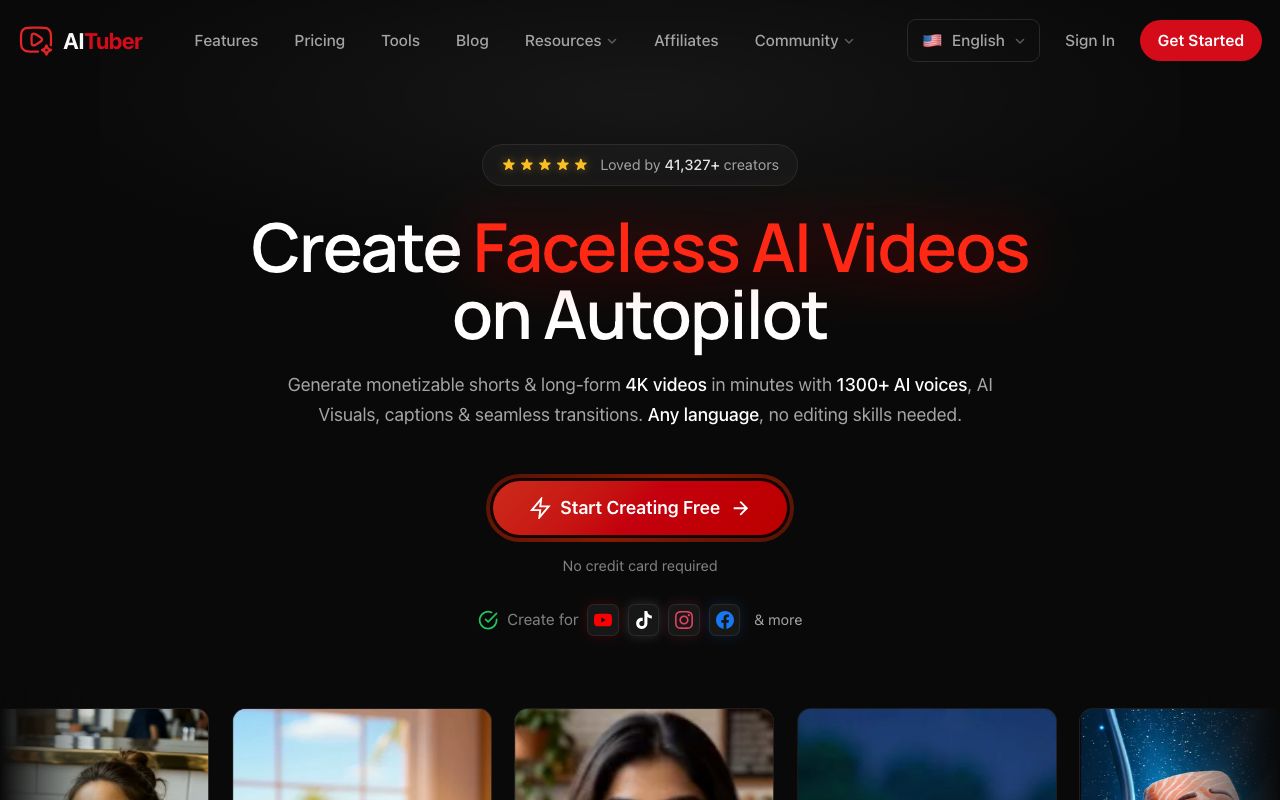
AITuber is the only tool on this list built around the whole faceless job, not one step of it. You give it an idea, and it writes the script, generates a matching AI voice and visuals, adds captions, and can post the finished video to your channel on a schedule. Credits are spent on the video you keep, not on every edit and preview, and a failed generation is auto-refunded. Try the AI faceless video generator directly to see the flow.
Key features
- Idea to finished video: script, AI voiceover, visuals, and captions in one flow
- Faceless niche templates (Reddit stories, true crime, mythology, history, psychology, and more)
- Autopilot that writes, makes, and posts videos to your channel on a schedule
- 1,300+ AI voices across 140+ languages
- 4K export, and every template, voice, and style included on every paid plan
Pros
- One idea becomes a complete, posted video, not a clip you still have to finish
- No feature gating: even the entry plan includes all templates, voices, styles, and 4K
- Credits are not spent on edits or previews, and failed jobs are refunded
- Unused credits never expire, so a slow month is not money wasted
- A free tier (100 credits) lets you make your first short before paying
Cons
- Focused on faceless short-form and channel automation, not long-form talking-head editing
- Autopilot is most useful if you actually run a channel on a schedule
Pricing: Free to start with 100 credits (no card). Paid plans are Creator $39/mo (2,500 credits, 1 channel on autopilot), Pro $69/mo (5,000 credits, 2 channels), Studio $129/mo (10,000 credits, 4 channels), and Agency $249/mo (20,000 credits, unlimited channels). Every plan includes all templates, voices, styles, and 4K export. See the full pricing.
Best for: creators who want to run a faceless YouTube channel end to end, from idea to posted video.
2. Fliki
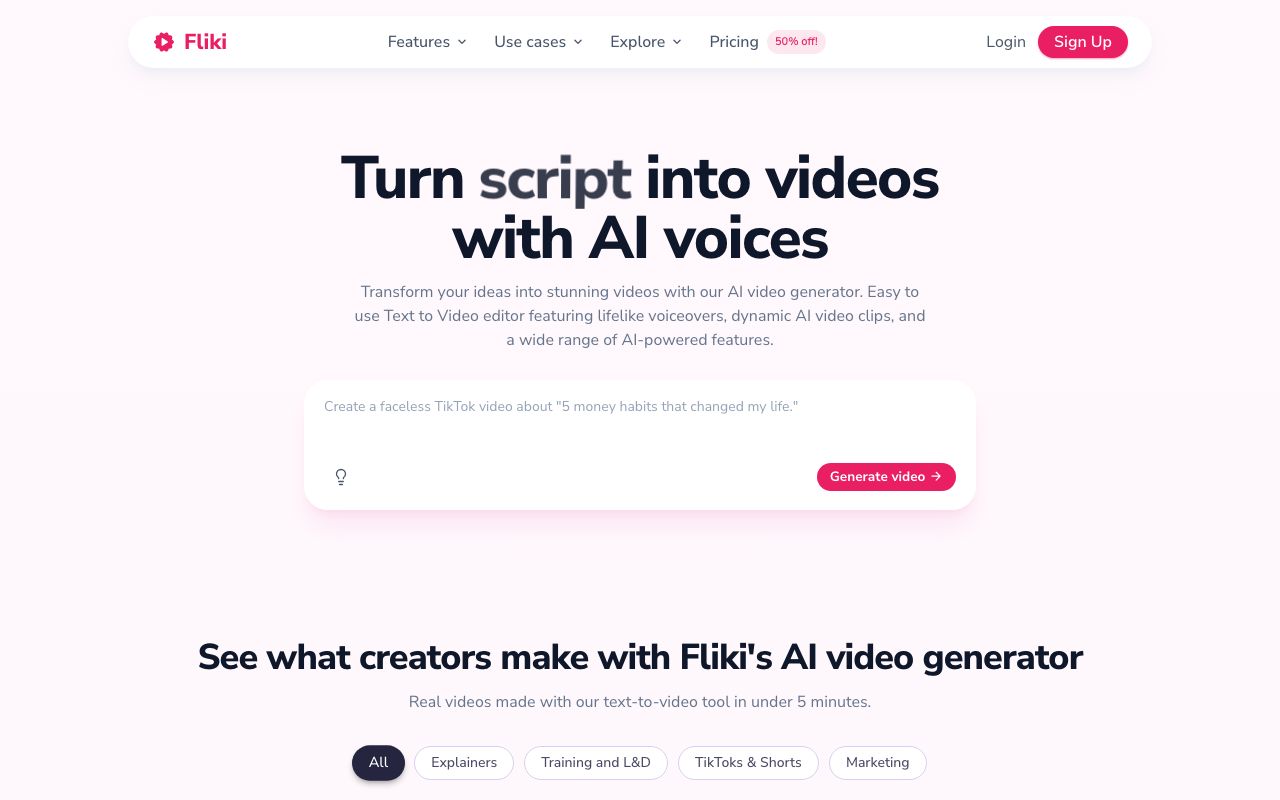
Fliki is the voice-first pick. You paste a script or a blog link, choose from a large library of lifelike AI voices, and it matches stock visuals to your words. For faceless videos where the narration carries the video and stock footage is fine, it is a solid, well-rated tool. It does not post for you, and its credits are spent while you edit, which is the most common complaint in its reviews.
Key features
- Script or blog to narrated video with stock visuals
- Around 1,000 voices on the Standard plan, with ultra-realistic options
- Voice cloning and 80+ languages
- 1080p export on paid plans, up to 15-minute videos on Standard
Pros
- One of the best AI voice libraries in the category
- Fast script-to-video flow that beginners pick up quickly
- Strong buyer ratings for ease of use
Cons
- Credits are spent on generating and previewing, not just the final export
- No auto-posting; you download and upload every video yourself
- The free plan is watermarked, capped, and has no commercial rights
Pricing (checked July 2026): Free plan is a small watermarked taster at 720p with no commercial rights. Standard runs about $28/mo month to month, or roughly $21/mo billed annually, and Premium is higher; Fliki shows rotating promo prices, so confirm on its site. Full breakdown in our Fliki pricing guide.
User reviews: 4.7/5 on G2 and 4.7/5 on Capterra from 345 reviews, but 3.7/5 on its app.fliki.ai Trustpilot profile, where the credit and support complaints show up. See our Fliki alternatives guide for the full story.
Best for: creators who write their own scripts and want the narration to sound human.
3. InVideo AI
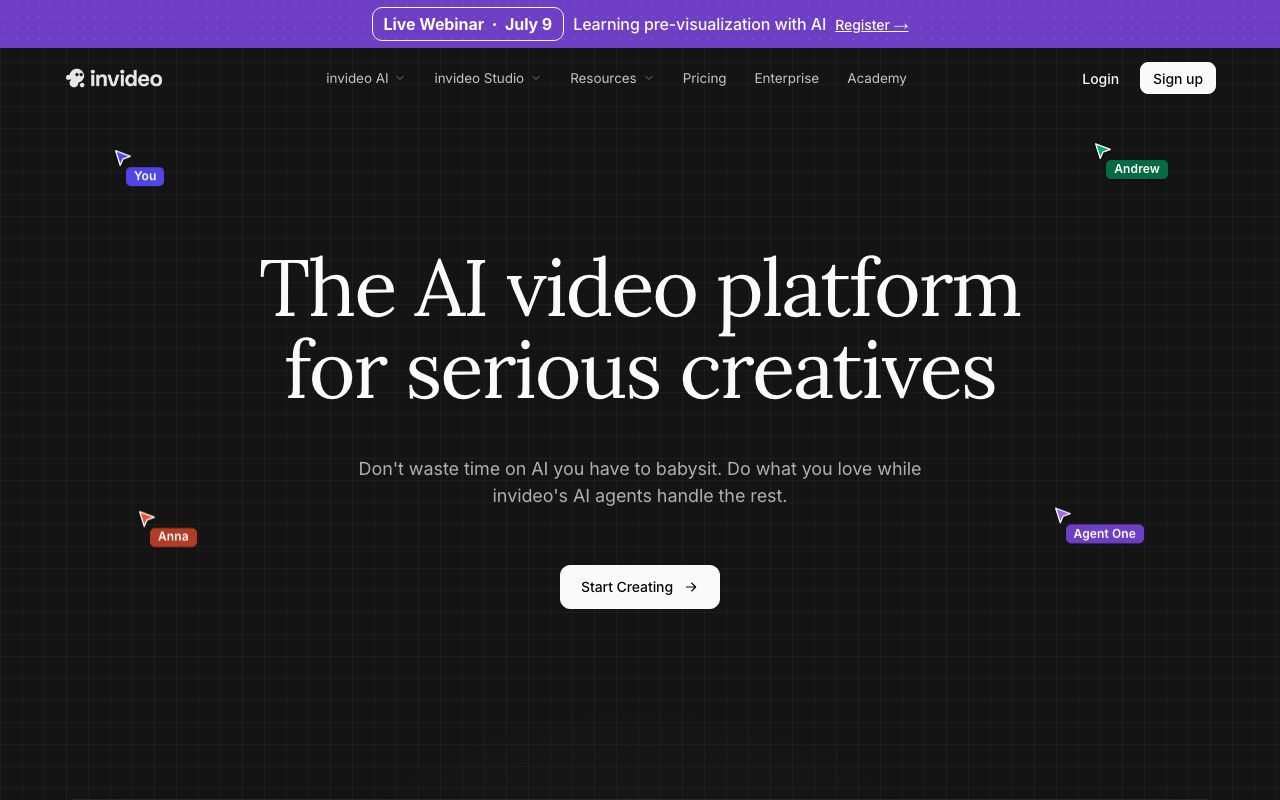
InVideo AI is the general-purpose prompt-to-video pick. You give it a text prompt, a script, or a blog URL, and it assembles scenes, stock footage, an AI voiceover, and captions. Its main trick is text-command editing: you type “make the intro shorter” instead of dragging clips on a timeline. It makes good faceless explainers, long or short, but it does not run a channel for you.
Key features
- Prompt, script, or blog URL to a full narrated video
- Text-command editing with no manual timeline
- Large iStock and Storyblocks library with multilingual AI voiceovers
- Voice cloning on paid plans
Pros
- Fast way to go from a prompt to a finished narrated video
- Huge stock and voice library
- Works well for long explainers, not only short videos
Cons
- No free plan since the July 2026 repricing, so testing means paying
- Unused credits expire at the end of each month
- Output can be inconsistent and often needs re-prompting, which burns credits
- The step from Plus to Max is five times the yearly price
Pricing (checked 27 July 2026 on InVideo’s pricing page): No free plan. Four paid tiers, each with unlimited exports and no watermark. Plus is $17/mo billed as $200 a year, for 75 credits a month. Max is $85/mo billed as $1,000 a year, for 390 credits. Generative is $170/mo billed as $2,000 a year, for 800 credits. Elite is $900/mo billed as $10,800 a year, for 4,250 credits. InVideo’s own FAQ says unused credits do not roll over, and generative models bill at their original API rates. Our best InVideo alternatives guide breaks down what changed.
User reviews: 4.5/5 on Capterra from 413 reviews (Capterra).
Best for: turning a prompt or a blog post into a narrated stock-footage video, long or short.
4. Pictory
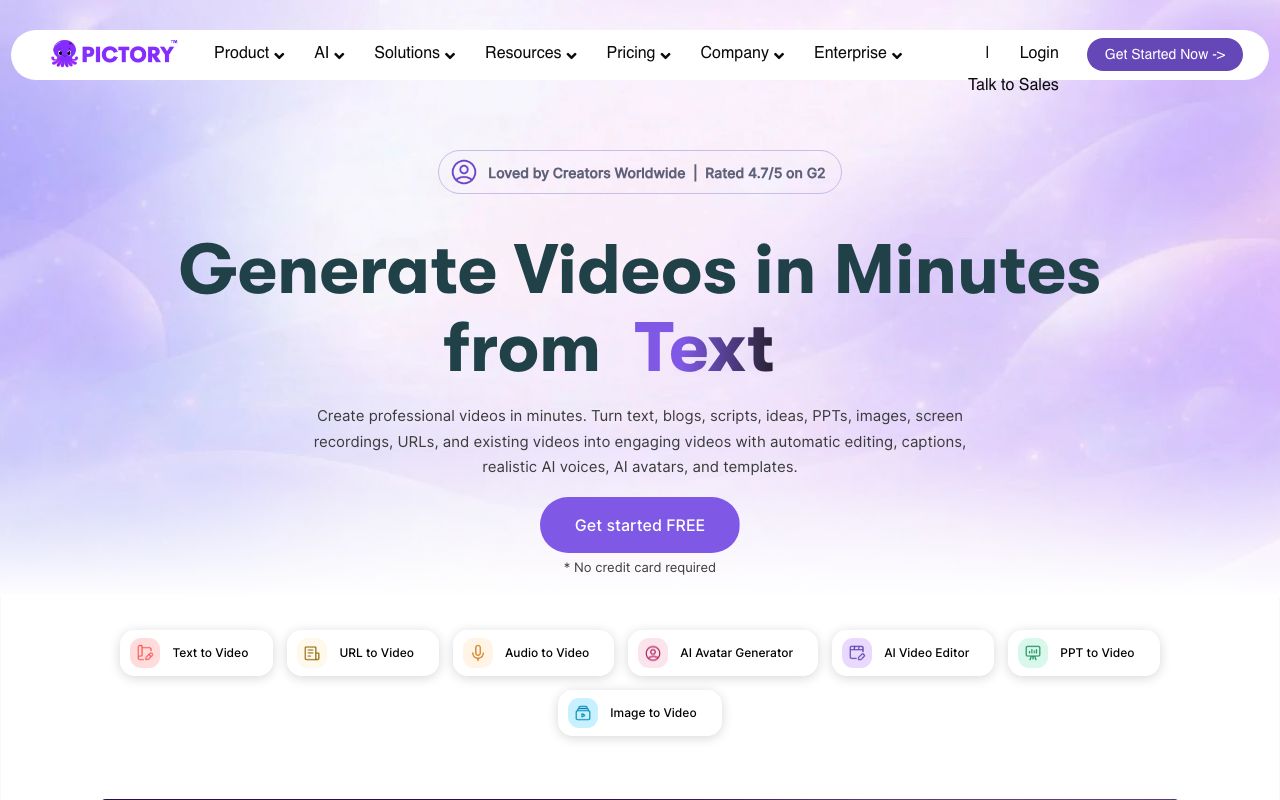
Pictory is the repurposing pick. It turns a blog post or a long video into short, captioned faceless clips with stock footage. If you already have a library of content and want to feed the shorts machine without filming anything new, this is its lane. It is credit-based, so watch usage the same way you would with Fliki.
Key features
- Blog-to-video and long-video-to-shorts in a few clicks
- Auto-captions and an AI voiceover
- Large stock footage and music library
- Text-based editing of the generated video
Pros
- Fast at chopping a long video or article into shorts
- Beginner-friendly for marketers repurposing content
- Strong auto-caption feature
Cons
- Stock footage is keyword-matched, so it often picks clips that miss the meaning
- Reviewers report a buggy editor and glitchy AI voiceover
- No free plan, only a trial
Pricing (checked July 2026): No free plan, only a trial. Starter is $25/mo billed annually or $29 month to month (200 video minutes). Professional is $35/mo annually or $59 monthly, and Team is $119/mo annually or $199 monthly.
User reviews: 4.7/5 on Capterra and 4.6/5 on G2, but 3.7/5 across 538 Trustpilot reviews. See our Pictory alternatives guide for the full breakdown.
Best for: marketers repurposing blogs and long videos into short faceless clips.
5. Revid.ai
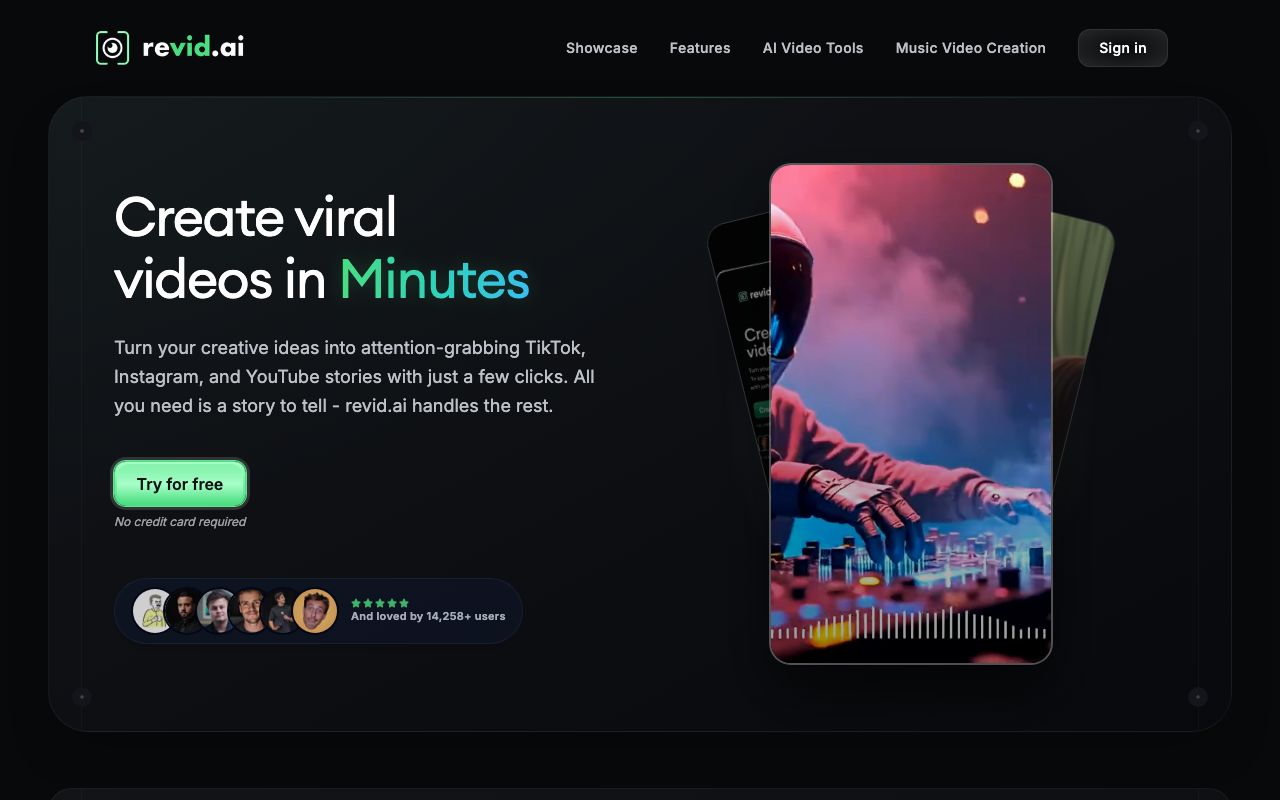
Revid.ai is built for viral faceless shorts at volume. You give it a prompt, script, or link, and it makes a short with an AI voice, captions, and templated visuals, then its Auto-Mode workers can generate and post to TikTok, Instagram, and YouTube on a schedule. The concept is strong; the recurring theme in its reviews is reliability.
Key features
- Prompt, script, or URL to a faceless short
- Auto-Mode workers that generate and post on a schedule
- Voiceovers in 70+ languages and a large viral-video remix library
Pros
- Purpose-built for faceless short-form
- Strong auto-generate-and-post automation
- Fast, simple workflow
Cons
- Recurring reliability complaints: credits lost on failed generations, characters that drift between scenes, and freezes
- Demo samples can look better than the real output
Pricing (checked July 2026): Hobby is $39/mo. Growth is listed at $99/mo but currently promoted at $39/mo, with 2,000 credits and 3 Auto-Mode workers. Ultra is $199/mo with 12,000 credits and 10 workers. You can start without a card; there is no permanent free plan.
User reviews: Trustpilot sentiment is mixed, around 3.x out of 5, with a high share of 1-star reviews citing reliability (Trustpilot).
Best for: solo creators mass-producing faceless TikTok and Shorts content on autopilot.
6. AutoShorts.ai
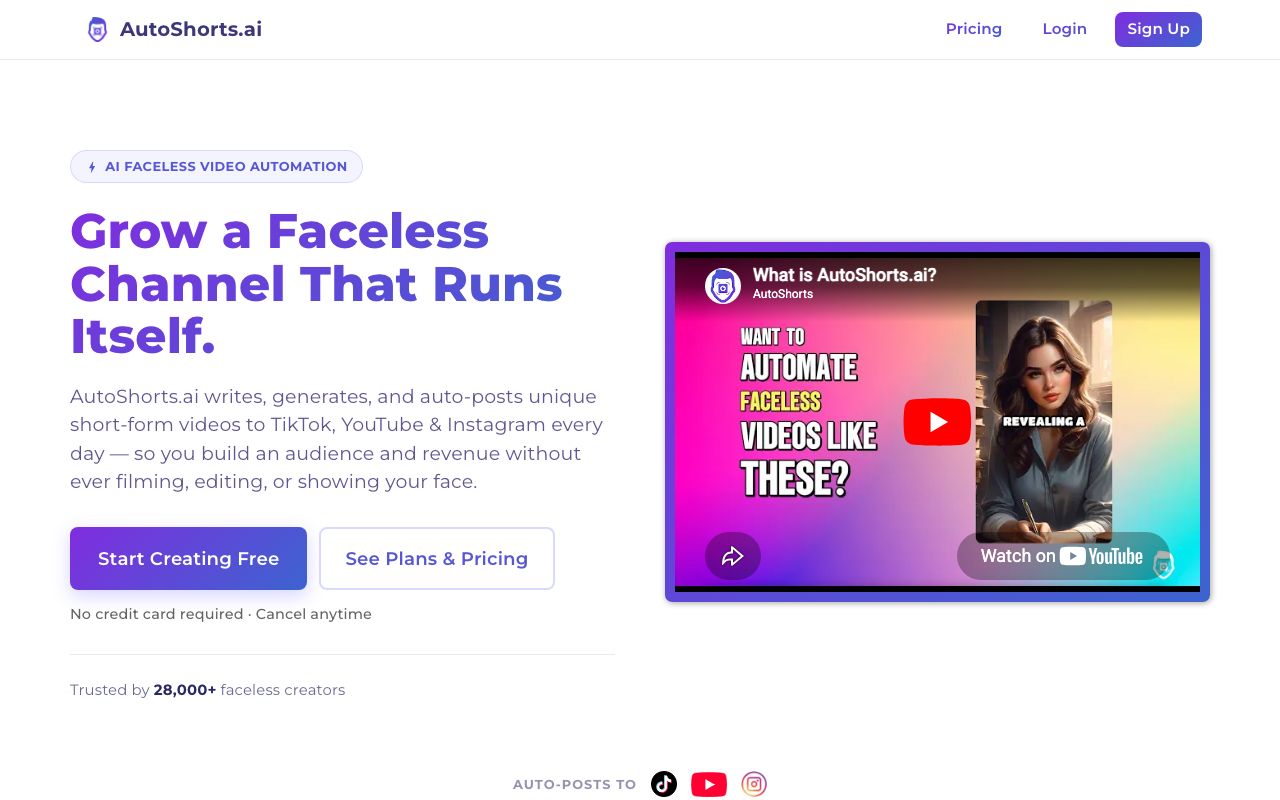
AutoShorts.ai is the cheapest set-and-forget option. You pick a niche, and it generates and auto-posts a faceless video series to your channels on a schedule. It trades control for convenience: you get less say over each video, but the channel keeps posting without you.
Key features
- Fully automated faceless series from a niche or topic
- Auto-posting to TikTok, YouTube Shorts, and Instagram Reels
- Script, AI visuals, AI voice, and voice cloning, all hands-off
Pros
- True set-and-forget automation
- Cheap entry point
- Purpose-built for faceless channels
Cons
- A thin third-party review footprint, so quality is harder to verify
- Output can be templated and repetitive, with limited fine editing
Pricing: Free plan with 1 video. Paid plans are commonly around $19/mo for about 3 posts a week, $39/mo for daily posting, and $69/mo for twice-daily posting. Confirm current pricing on its site.
User reviews: limited third-party reviews so far; most feedback comes from hands-on test articles rather than large review platforms, so weigh it carefully.
Best for: people who want a fully automated faceless channel with minimal touch.
7. Vidnoz AI
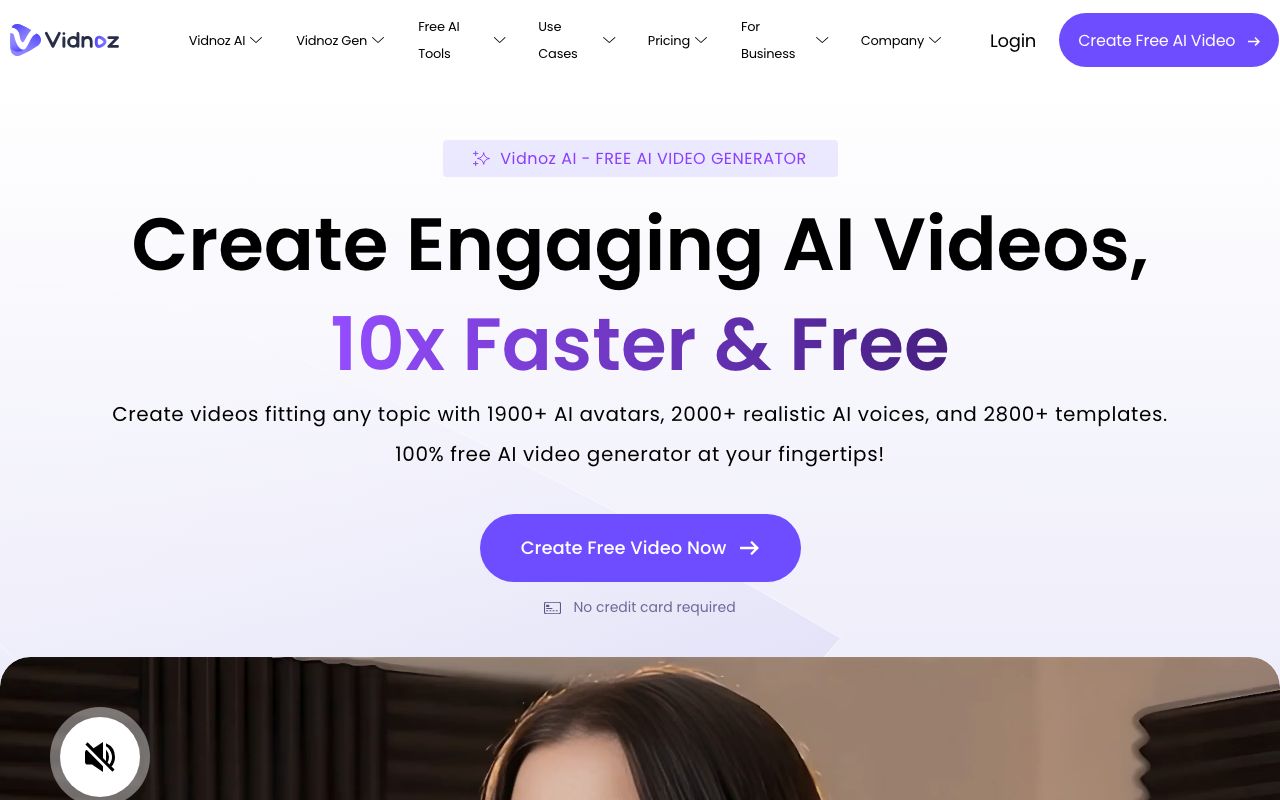
Vidnoz AI is the budget experiment pick. It is an all-in-one toolkit centered on AI avatars and voices, with an unusually generous free tier. Its avatar focus means much of it is not strictly faceless, but it can make narrated clips, and the free daily credits make it a low-risk way to test AI video before spending anything.
Key features
- 1,800+ avatars and 2,600+ voices
- A large free plan with daily credits
- Extras like face-swap, photo-to-avatar, and video translation
Pros
- Very generous free plan
- Huge avatar, template, and voice library
- Broad toolkit for the price
Cons
- A big gap between review sites: strong on G2 but many billing and cancellation complaints on Trustpilot
- The credit system is confusing, and the free tier is watermarked and length-capped
Pricing: Free plan with daily credits, up to 3-minute videos, 720p, and a watermark. Paid Starter and Business tiers are credit-based, with discounts on annual billing. Pricing shifts with promos, so check the current page.
User reviews: about 4.9/5 on G2 from a small sample of roughly 16 reviews (G2), versus about 2.3/5 on Trustpilot from roughly 79 reviews, where billing complaints dominate (Trustpilot). Read both before you buy.
Best for: budget users who want to experiment with AI video before paying.
Quick comparison of all seven tools
| Tool | Starting price | Free tier | Auto-posting | Best for |
|---|---|---|---|---|
| AITuber | Free, then $39/mo | Yes, 100 credits | Yes, full autopilot | Idea to posted faceless video |
| Fliki | About $21/mo (annual) | Yes, watermarked | No | Script narration with AI voices |
| InVideo AI | $17/mo (annual, $200/yr) | No, free plan dropped | No | Prompt or blog to narrated video |
| Pictory | $25/mo (annual) | Trial only | No | Long video and blog to shorts |
| Revid.ai | $39/mo | Trial only | Yes | Viral shorts on autopilot |
| AutoShorts.ai | About $19/mo | Paused since July 2026 | Yes | Fully automated channel |
| Vidnoz AI | Free plus credits | Yes, daily credits | No | Budget experimenting |
Prices are the lowest paid tier as of July 2026 and are rounded; some vendors render pricing dynamically, so check each site for the exact figure. InVideo repriced on 27 July 2026 and dropped its free plan, which our best InVideo alternatives guide covers in full. AutoShorts.ai still lists a $0 free plan, but has suspended it. Its FAQ blames bot abuse and says the plan will come back. Checked 31 July 2026. For the auto-posting tools, our best YouTube automation tools guide goes deeper.
How to choose the right faceless video generator
- Do you want the channel to run itself? If yes, AITuber. It takes an idea to a posted video and runs on autopilot, without spending credits while you edit. AutoShorts.ai is the cheaper, lower-control version of the same idea.
- Do you write your own scripts and just need narration? If yes, Fliki. Its voice library is the best reason to pick it.
- Do you mainly repurpose blogs or long videos? If yes, Pictory or InVideo AI are built for exactly that.
- Do you want maximum volume on TikTok? If yes, Revid.ai, with the reliability caveats above in mind.
- Is budget your main limit? If yes, Vidnoz AI’s free tier or AITuber’s 100 free credits let you start at $0.
Use-case cheat sheet
- Scenario: You want to launch a faceless niche channel and post daily. Best choice: AITuber. It goes from idea to posted video on autopilot, with all features included.
- Scenario: You have no channel idea yet. Best choice: Browse our faceless YouTube channel ideas, then start with AITuber’s niche templates.
- Scenario: You write scripts and want them narrated with a lifelike voice. Best choice: Fliki, or AITuber if you also want it posted.
- Scenario: You have a blog and want each post turned into a video. Best choice: InVideo AI. Paste the URL and it builds the video.
- Scenario: You want to chop long videos into shorts. Best choice: Pictory, which is built for repurposing.
- Scenario: You want to mass-produce viral TikToks that post themselves. Best choice: Revid.ai or AutoShorts.ai, with the reliability caveats above in mind.
- Scenario: You keep losing credits to edits and re-generations. Best choice: AITuber. Credits count only on the video you keep, and failed jobs are refunded.
- Scenario: You want the biggest free allowance to experiment. Best choice: Vidnoz AI, or AITuber’s 100 free credits.
- Scenario: You are an agency running many client channels. Best choice: AITuber’s Agency plan (unlimited channels).
Frequently Asked Questions
Basics
What is the best AI faceless video generator?
AITuber is the best faceless video generator for most creators in 2026 because it covers the whole job: it writes the script, generates the AI voice and visuals, adds captions, and posts the finished video to your channel on a schedule. Fliki is the best pick if you write your own scripts and only need narration, and Pictory or InVideo AI are best for repurposing existing content.
What is a faceless video generator?
A faceless video generator is an AI tool that makes complete videos without anyone appearing on camera. It turns an idea, script, or link into a video with an AI voiceover, matching visuals, and captions. Creators use them to run channels in niches like Reddit stories, history, psychology, and finance, where the story matters more than a face.
Are faceless channels allowed on YouTube?
Yes. YouTube allows faceless channels and monetizes them like any other channel, as long as the content is original and adds value rather than reusing others’ work. AI-made videos qualify when you add your own script, structure, and voice. Our YouTube automation guide covers the policies in plain words.
Free and pricing
Is there a free AI faceless video generator?
Yes. AITuber gives you 100 free credits with no card, Vidnoz AI has a generous free plan with daily credits, and Fliki has a watermarked free tier. InVideo AI used to have one, but its July 2026 pricing page lists paid plans only. Free tiers are for testing; watermarks and missing commercial rights mean you will want a paid plan before publishing seriously.
How much does a faceless video generator cost?
Entry paid plans run from about $19/mo (AutoShorts.ai) to $39/mo (Revid.ai) as of July 2026. AITuber starts at $39/mo with every feature included, Fliki lands around $21 to $28/mo, InVideo AI is $17/mo but only billed yearly at $200, and Pictory starts at $25/mo billed annually. The bigger cost difference is usually credits: tools that burn credits on edits cost more in practice than their sticker price suggests.
Comparisons
What is the difference between a faceless video generator and a YouTube automation tool?
A faceless video generator makes the videos. A YouTube automation tool also handles the publishing: scheduling, uploading, and posting. Some tools are both; AITuber, Revid.ai, and AutoShorts.ai generate the video and post it, while Fliki, Pictory, and InVideo AI stop at the finished file.
Is AITuber or Fliki better for faceless videos?
AITuber is better if you want the whole pipeline: original videos from one idea, niche templates, and autopilot posting, with credits only spent on output. Fliki is better if you write your own scripts and the priority is a large library of lifelike narration voices. Both have free tiers, so you can test each in an afternoon.
How we researched this: we compared seven tools against the criteria above, using public sources (each vendor’s live pricing page and named review platforms like G2, Capterra, and Trustpilot), checked in July 2026, combined with our own hands-on testing. AITuber is a product we build, so we have flagged every place we compare it to another tool and kept the competitor pricing and ratings accurate as of the date above. Several vendors render pricing dynamically or run promos, so treat their dollar figures as approximate and confirm on their sites. Prices and plans change often.